
Facebook Ad CPM: Why It's So High (2026)
What Facebook ad CPM is, how Meta's auction prices it, why it spikes in Q4 and with stale creative, and the one lever that reliably brings it down.
Updated July 2026 · Likit Sae Lee, CTO
CPM is what you pay for 1,000 ad impressions, found in Ads Manager: divide spend by impressions and multiply by 1,000. On Facebook it is set by a live auction, not a rate card, so Meta weighs your bid, the predicted chance a person acts on the ad, and the ad's quality. CPMs across Facebook and Instagram averaged $8.19 in 2025, but the number swings with your industry, country, objective, the calendar (Black Friday 2024 averaged $16.85), placement mix, and how people respond to your creative. Most of those drivers are outside your control; the one you own is the creative, because ads people engage with win auctions at lower cost and fresh variations reset the CPM creep that fatigue causes.
The audience has not changed, the budget has not changed, and yet every thousand impressions costs more than it did last month. CPM is the metric advertisers stare at hardest and understand least, because it looks like a price when it is actually a score: the output of an auction that reprices your ad every single time someone opens a feed. Once you know what feeds that auction, the mystery mostly dissolves. A few of the drivers are seasonal and structural, and no setting in Ads Manager touches them. One driver is entirely yours, and it happens to be the strongest.
What CPM is and how to calculate it
CPM is your cost per 1,000 impressions, where the M is the Roman numeral for a thousand. The formula is spend divided by impressions, multiplied by 1,000: spend $50 to buy 5,000 impressions and your CPM was $10. It is the cleanest measure of what reach costs you, before clicks, leads, or purchases enter the picture.
You rarely do the arithmetic by hand, because Ads Manager reports it for you. The metric is labelled "CPM (cost per 1,000 impressions)" in your results table. If the column is missing, open the Columns dropdown and switch to a Performance or Delivery preset, or use Customise Columns to tick CPM, frequency, and quality ranking so the numbers you diagnose with sit side by side. Read it at the ad level, not just the campaign level, because one fatigued ad can drag a whole campaign's blended CPM up.
The number is not a price Meta publishes anywhere. Every time someone opens a feed, an auction runs among all the advertisers who want that one impression, and Meta's own documentation is explicit that the highest bid does not automatically win. The auction weighs three things together: your bid, the estimated action rate (the predicted chance this person takes the action you optimized for), and the quality of the ad itself. The impression goes to the highest combined value, and your CPM falls out of that competition.
This explains something that confuses a lot of advertisers: two brands can target the same people in the same week and pay wildly different CPMs. The auction is not pricing the person; it is pricing how much value your specific ad is predicted to create when that person sees it.
What a normal CPM looks like in 2026
Across Facebook and Instagram, CPMs averaged $8.19 in 2025, per Gupta Media's analysis of tens of millions of impressions. Treat that as a midpoint, not a target: a retargeting campaign in a competitive niche can run at several times the average with nothing wrong at all. Three context layers decide whether your CPM is normal, and none of them is the headline average:
| Context | How it moves your CPM |
|---|---|
| Industry | High-intent verticals with deep-pocketed advertisers (finance, insurance) bid more aggressively, so their cost to reach the same person runs higher. Compare against your own vertical, not the blended average. |
| Country | The market you target is the biggest swing. Wealthy, saturated markets like the United States are the most expensive places to buy attention; emerging markets cost a fraction of that for the same 1,000 views. Never benchmark one market against another. |
| Objective | Reach and awareness campaigns are cheap to deliver because Meta only has to show the ad. Sales and leads campaigns ask it to find a scarcer, higher-intent audience, so they cost more per thousand by design. |
The direction of travel is up. Meta reported that its average price per ad rose 9% year over year across 2025, even as ad impressions grew 12%: advertiser demand keeps growing faster than human attention, so the baseline drifts higher every year. Comparing your CPM to the same month last year is fair; expecting it to return to what you paid three years ago is not.
One more reason not to judge a number too fast: a brand-new ad set is unstable by design. Meta runs a learning phase after you publish or significantly edit it, needing roughly 50 optimization events in about a week to exit, and CPM swings day to day until it does. Judging a CPM in the first 48 hours is reading noise.
The drivers of your CPM
The context layers above (industry, country, objective) set the floor by deciding who else wants the same impressions; well-funded, high-intent niches simply cost more because more budgets chase fewer eyeballs. On top of that floor, four levers move your number day to day.
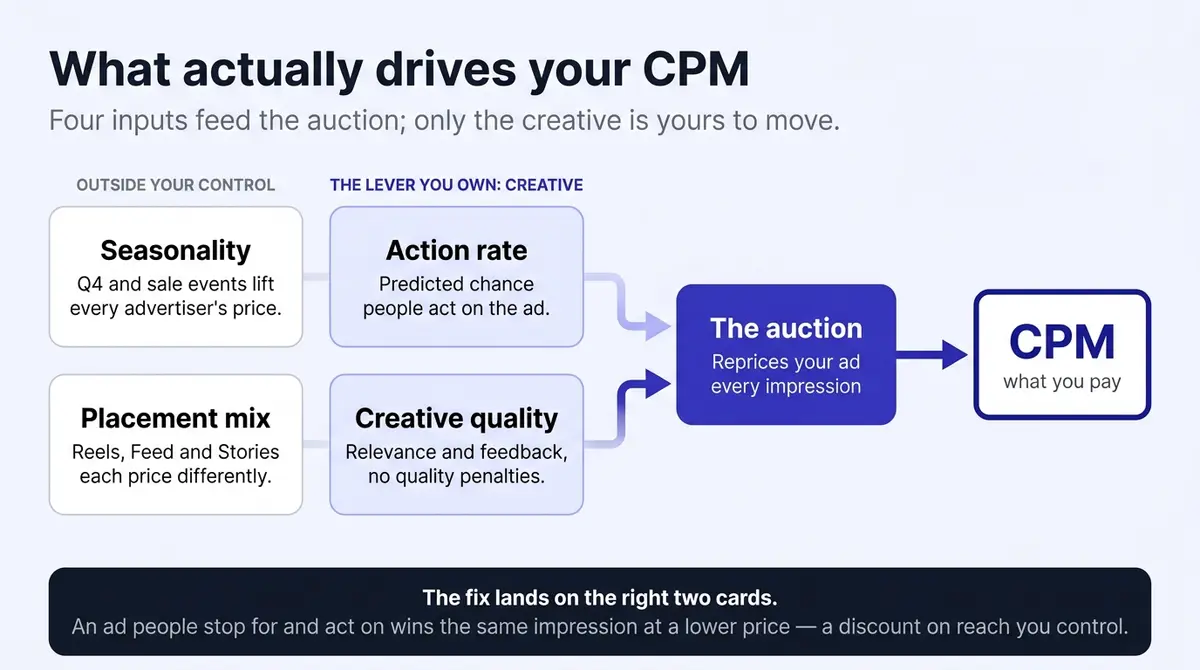
Seasonality. Q4 is expensive for everyone because every retailer's budget arrives at once. Black Friday 2024 averaged a $16.85 CPM, roughly double the year's average, with Cyber Monday higher still, and rates fall sharply once the holidays end. None of this reflects your account. It is the calendar, and the section below breaks the 2025 year into a planning floor and a peak.
Placement mix. Feed, Reels, Stories, Messenger, and the Audience Network each carry their own supply and demand, so the blend you allow changes your blended price. Letting Meta place across everything usually lowers the average; restricting delivery to one premium placement does the opposite. The gap is wide enough to be worth its own section, just ahead.
Estimated action rates. When Meta predicts your audience is unlikely to take the action you optimized for, your ad needs a bigger effective bid to win the same impression, and that surfaces as a higher CPM. A conversion campaign pointed at a cold, poorly matched audience gets expensive fast, because the system compensates for weak predicted response with your money.
Creative quality. Meta scores ads for low-quality attributes (engagement bait, withheld information, sensationalized language) and demotes offenders in the auction, so the penalty shows up as paying more for the same reach.
Of these four, the calendar is fixed and placements are one setting worth checking once. The last two, predicted response and quality, both trace back to the creative, the one input you fully control.
Predicted response and quality are not abstractions: Meta exposes them as readouts you can open per ad and per account. The first is ad relevance diagnostics, three rankings Meta surfaces once an ad clears about 500 impressions: quality ranking, engagement rate ranking, and conversion rate ranking. Each is scored below average, average, or above average against the ads competing for your audience, so they are comparative, not absolute, and each is triage. A below-average engagement ranking points at the hook and first frame (people are not stopping); a below-average conversion ranking points past the click, at the offer or landing page; a below-average quality ranking usually means the ad is tripping a low-quality attribute or collecting hides. Each is the auction saying rivals out-compete you on that dimension, and the surcharge lands in your CPM.
The second sits at the account level: the customer feedback score, a 0 to 5 rating Meta builds from post-purchase surveys sent to people who bought through your ads, visible under Account Quality. It captures what the creative cannot: shipping times, product accuracy, support. Meta treats a low score as a delivery signal, so dropping toward the bottom of the scale makes your ads cost more, and sinking far enough can restrict the account's ability to advertise at all. It is the one CPM driver that lives in operations, not the ad account: a slow-shipping quarter can quietly raise the price of every impression you buy.
CPM by placement: why Reels is the cheapest seat in the auction
The placement bullet above is worth a closer look, because the gap between placements is bigger than most advertisers assume. Each surface (Feed, Reels, Stories, Messenger, Audience Network) is its own little auction with its own supply of inventory and its own crowd of bidders, so the seat you buy changes the price as much as the audience you target.
Gupta Media's placement tracking makes the spread concrete. In January 2025 the average CPM for Instagram Stories ads was $7.25, while Instagram Reels ads averaged just $4.29: roughly a third cheaper for the same thousand views inside the same app.
| Instagram placement | Average CPM, January 2025 | Why |
|---|---|---|
| Reels | $4.29 | Newer inventory Meta is still building advertiser demand for, so supply outpaces competition. |
| Stories | $7.25 | Mature, full-screen format with a deep bench of established advertisers bidding for it. |
Treat those figures as directional, from a vendor tracker rather than Meta's own reporting, but the pattern is consistent: Reels has stayed the most affordable primary placement as Meta pushes adoption of the format, and Feed remains the most contested seat in the house. The practical move is not to hard-pin every campaign to Reels, though. Cheaper reach is not automatically cheaper results, and a low-CPM placement that converts poorly is no bargain. The win is to open placements (or run Advantage+ placements) so Meta can route each impression to whichever surface is cheapest for your specific result, instead of restricting delivery to one premium seat and paying for the privilege.
Signal loss is the quiet structural driver under all of this
The four levers above explain why your CPM moves week to week. There is a fifth force that explains why everyone's baseline drifted upward and stayed there, and it is the one the auction's own machinery depends on: the estimated action rate is a prediction, and a prediction is only as good as the signal feeding it.
That signal got structurally worse in 2021. Apple's App Tracking Transparency prompt let iPhone users opt out of the cross-app tracking Meta had used to learn who converts, and most of them did. With less data to predict relevance, the system got measurably less accurate at matching ads to the people likely to act. A study from the University of Maryland's Robert H. Smith School of Business quantified the shock: click-throughs on ads fell 37.1% as people saw less relevant ads, advertiser revenue dropped about 37% on average, and Meta's own ad spending declined 6.8% as the platform became less effective at delivering results. Small, direct-to-consumer businesses heavily dependent on Facebook took the hardest hit, around a 60% drop in revenue relative to firms less exposed to digital advertising.
The mechanism matters more than the headline numbers. When the engine is less sure a given impression will pay off, it has to compensate, and the way an auction compensates is with a bigger effective bid to win the same slot. Less signal, higher cost to reach the same person. That is the structural floor under "estimated action rates," and it is permanent: the data did not come back.
It also reframes the creative-volume argument from a fatigue trick into a signal-recovery one. Every distinct concept, format, and angle you run gives the prediction engine something fresh to match on, partly rebuilding the signal ATT removed. Running one ad starves the model; running a varied, refreshed set feeds it. That is why the advertisers who held their costs steadiest through the privacy shift were the ones shipping the most creative, not the ones with the cleverest bid settings.
The 2025 calendar in numbers: a tight off-peak floor, then the Q4 climb
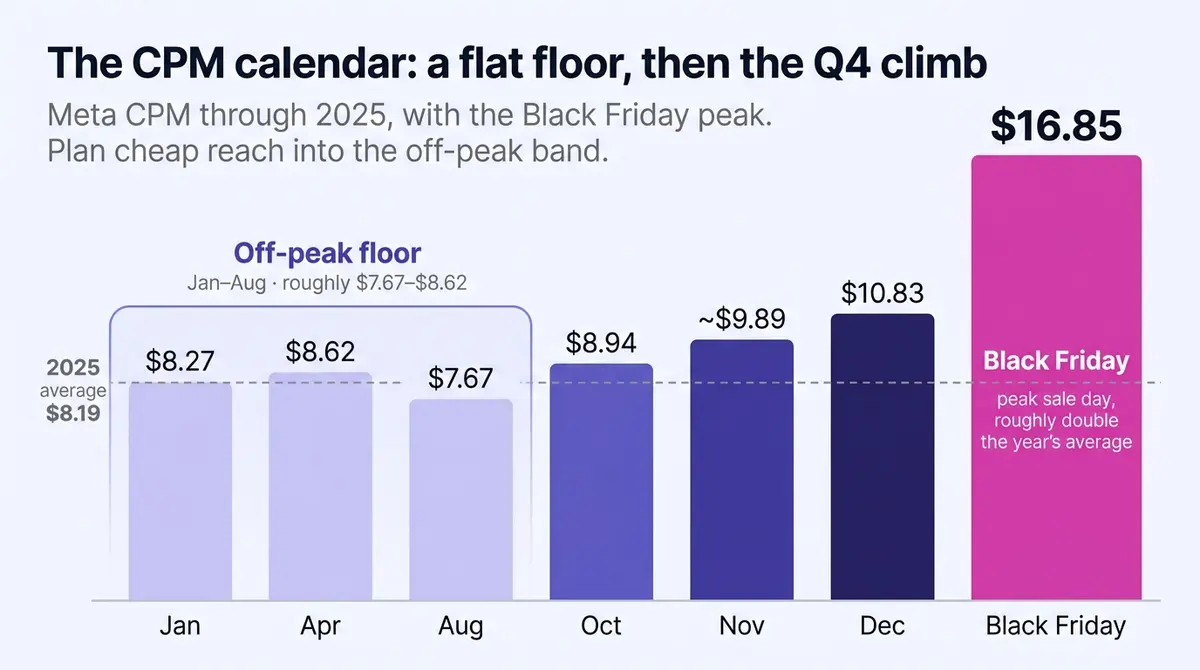
Seasonality is the most predictable driver, so it is the easiest to plan around once you know the shape of the year. Gupta Media's 2025 monthly tracking held Meta CPM in a tight band through the first three quarters: $8.27 in January, peaking at $8.62 in April, and bottoming at $7.67 in August. That roughly $7.67 to $8.62 floor is the number to plan testing, list-building, and awareness spend around, because it is what reach costs when the retail calendar is quiet.
Then comes the Q4 climb, and 2025 added a useful wrinkle to the usual "Q4 is expensive" story. At the platform level the holiday surge came more from volume than from price: Meta reported Q4 2025 ad impressions up 18% year over year while average price per ad rose only 6%, a sharper split toward volume than the full-year figures (impressions +12%, price +9%). In plain terms, 2025's fourth quarter was busier more than it was pricier across Meta as a whole, even though individual retail accounts still saw real CPM spikes from concentrated competition on peak sale days. The demand behind those costs kept compounding regardless: Meta's advertising revenue reached $58.1 billion in Q4 2025 alone and $196.2 billion for the full year, so the long-run pressure on the baseline is not going away.
The efficiency improvements Meta touted for that quarter came from its ranking AI, not from cheaper reach: the company reported a directional 3% lift in clicks on Facebook and a 1% boost to conversions on Instagram off the back of optimization gains. The lesson for planning is that you cannot wait for CPM to fall back to last year's number. The lever you control is feeding that ranking engine better creative, so more of your impressions land on people likely to respond.
Conversion objectives feel the calendar hardest, because the audiences they chase are the ones everyone competes for at year end. A neutral 2025 benchmark puts the average Facebook cost per lead at $27.66, up 20.94% from $22.87 a year earlier, while the average lead-campaign conversion rate slipped to 7.72% from 8.67%: costs up, conversion down, the squeeze that makes a disciplined creative routine pay for itself. The takeaway is a calendar move, not a panic: pull awareness and testing into the cheap off-peak months on a modest budget, then concentrate conversion spend into the major sale windows, the Black Friday and Cyber Monday stretch, the year-end and other regional mega-sale days, when the higher CPM is the price of being where the buyers are.
A five-minute diagnosis for a high CPM
Before rebuilding campaigns, open Ads Manager and check these in order. Frequency first: if it is climbing while CTR falls, the audience has seen the ad too many times and delivery gets steadily more expensive. A commonly cited healthy frequency range is roughly 1.8 to 4, with typical accounts near the low end, and once you push past about 4 response falls off. Then the calendar: compare against the same weeks last year, because if it is November, the answer may simply be November. Then audience size: a pool under a few hundred thousand people forces the auction to reuse the same impressions. Then the placement breakdown: one placement quietly eating budget at triple the CPM of the rest is common and fixable in a minute.
Last, check engagement against a benchmark. The average CTR for Facebook traffic campaigns was 1.71% in 2025, per WordStream, though the range is wide by vertical (shopping and gifts averaged 4.13%, automotive repair just 0.80%). Sit well below your own vertical's norm for weeks and the auction taxes you for it, because low engagement reads as low predicted value.
Frequency is also a lever, but a narrow one: Meta lets you set a hard frequency cap only on Awareness-objective campaigns, at the ad-set stage. On sales and leads campaigns there is no cap to set, so the only way to hold frequency down is to keep fresh creative in rotation.
The other instinct, once those checks are done, is to reach for the bid. None of the bid controls lowers the auction's price, so it helps to know what they actually do. Highest volume (the default, once called lowest cost) spends your budget for as many results as it can with no ceiling, so your cost per result floats with competition. A cost cap gives Meta a target average cost per result and lets it trade dearer and cheaper conversions as long as the average holds. A bid cap sets a hard maximum bid per auction, so Meta does not bid above your number and may underspend if it cannot find cheap enough impressions.
These are delivery controls, not coupons. A cap protects your cost per result by skipping the expensive impressions, not by making them cheaper, and one set too tight just stalls delivery. None of them changes how the system values your ad. The lever that does is the creative: an ad people stop for, click, and buy from carries a stronger estimated action rate, so it can take the impression from a richer competitor, which is functionally a discount on reach.
Why creative volume now matters as much as freshness
Fresh variations have always mattered, but Meta's delivery system has changed what "enough creative" means. In late 2024 Meta rolled out Andromeda, a retrieval engine that sits at the front of ad delivery. Meta's own engineering team describes it selecting ads "from tens of millions of ad candidates into a few thousand relevant ad candidates" before the ranking auction even runs.
So the breadth of your creative is now part of how you get matched, not just how you avoid fatigue. The more distinct concepts, formats, and angles you run, the more chances the engine has to pair one with each person it scores, so more of your impressions reach people likely to respond, and that predicted response is what keeps CPM down. As one neutral analysis put it, broader campaigns with more creative inputs give the engine more options to match ads to users; a single ad, however good, gives it almost nothing to work with. The point is not near-duplicates: run several genuinely different ideas (different hooks, formats, and personas) and keep refreshing them.
Genuinely different is easier to see in a real feed than in theory. Real skincare brands in the archive cover the spread well: Skinlycious leans on testimonial video, a mum on camera describing her daughter's forehead pimples clearing; Shakura runs before-and-after creative, stubborn dark spots faded without laser, anchored to an RM68 two-session offer; Hexkin keeps it problem and solution, glowing skin without needles, just a water-light cream. A testimonial, a transformation with a price, a straight fix. Three distinct reasons to stop the scroll, and the kind of variety a retrieval engine can actually work with inside one account.
Fatigue, meanwhile, still compounds quietly, and no targeting change cures it, because the same people keep meeting the same ad. The advertisers who hold CPMs steady through Q4 are not better bidders: they never let one creative carry the account long enough to decay.
Read CPM next to the metrics it lives with
CPM is a delivery metric, and read alone it lies in both directions. A high CPM is not proof of failure: an expensive audience that buys beats a cheap one that scrolls past, so a high CPM with strong CTR and conversion rates is often a winning trade. A low CPM is not proof of success either, because a $4 audience that never converts is the most expensive reach you can buy. Sort your reporting into the two jobs each metric does:
| Metric | What it answers | Type |
|---|---|---|
| CPM | What do 1,000 impressions cost? | Delivery |
| Frequency | How often has one person seen this? | Delivery |
| CTR | Is the creative earning the click? | Performance |
| Cost per result or ROAS | Is the spend actually profitable? | Performance |
Diagnose cost per result first, CPM second, and let the delivery metrics explain the performance ones instead of reading any single number as a verdict. The pairing to fear is a high CPM next to weak engagement: the auction rates the ad poorly and you are paying a premium for attention nobody returns.
Turn the number into a routine
Three habits cover almost everything in this article. First, review frequency and CTR weekly, per ad, so fatigue shows up before the CPM chart does. Second, budget for the calendar: assume peak sale days like Black Friday cost roughly double, with Meta CPMs climbing every month through Q4 (from $8.94 in October 2024 to $10.83 by December, per Gupta Media), and move awareness, list-building, and testing into the cheap months. Third, keep variations moving, with two or three fresh creatives ready before the current winner fades, because the gap between spotting fatigue and shipping the replacement is where money leaks. If the campaign setup around all this is what you are unsure of, the walkthrough in how to run a Facebook ad covers it step by step. A platform like AdPlay.ai keeps research, generation, editing, and Meta launch in one place, which shortens that replacement gap, but the habit is the point: when CPM creeps, the fix is a fresh ad.
By the numbers
Frequently asked questions
What is a good CPM for Facebook ads?
CPMs across Facebook and Instagram averaged $8.19 in 2025, but a good CPM is relative to your industry, country, audience, season, and objective. A retargeting campaign paying a $25 CPM that converts profitably is healthy; a $5 CPM that never sells anything is expensive. Compare your CPM against your own account history at the same time of year, and judge campaigns on cost per result, not on the cost of reach alone.
Did Apple's iOS privacy changes make Facebook ads more expensive?
Indirectly, yes. Apple's App Tracking Transparency cut the conversion signal Meta uses to predict who will act, so the system got less accurate at matching ads to people. A University of Maryland Smith School study found click-throughs on Facebook ads fell about 37%, advertiser revenue dropped a similar amount, and small Facebook-dependent businesses were hit hardest. Less signal means Meta needs a bigger effective bid to win the same impression, which surfaces as a higher CPM. It is also why running more varied creative now matters: it gives the engine more to match on, partly restoring the signal ATT removed.
Why is my Facebook CPM so high?
Check the usual suspects in order. Creative fatigue: frequency climbing while CTR falls means the audience is tired of the ad and delivery gets pricier. The calendar: Q4 and major sale events inflate every advertiser's CPM. Audience size: small retargeting pools and narrow interest stacks force more bidders into fewer impressions. Placements: restricting to one premium placement removes Meta's cheaper inventory. And weak engagement: if people rarely act on the ad, the auction makes you pay a premium to win the same slot.
Why is my lead or sales CPM higher than my awareness CPM?
Because the auction is pricing a scarcer outcome. An awareness or reach campaign only needs to show your ad to people, so Meta has wide inventory to fill cheaply. A leads or sales campaign asks Meta to find the smaller pool of people predicted to convert, a higher-intent segment many advertisers compete for, so the effective price per thousand rises. A higher CPM on a conversion objective is normal, not a fault: judge it on cost per result, not on the cost of reach.
What are Meta's ad relevance diagnostics?
Three rankings Meta shows once an ad passes 500 impressions: quality ranking, engagement rate ranking, and conversion rate ranking, each rated below average, average, or above average against ads competing for the same audience. They are comparative, not absolute, so a below-average score means rivals are out-competing you on that dimension, which the auction translates into higher costs. Read them together: weak engagement points at the hook, weak conversion at the offer or landing page.
What frequency is too high, and can I cap it?
Frequency is how many times the average person has seen your ad. A commonly cited healthy range is roughly 1.8 to 4 before fatigue starts dragging on results, with one neutral benchmark putting typical B2C frequency near 2.4. Past about 4, response usually falls and CPM creeps up. You can set a hard frequency cap, but only on Awareness-objective campaigns, at the ad-set stage under Optimization and Delivery. On sales and leads campaigns there is no cap setting, so you manage fatigue by rotating fresh creative instead.
How do I lower my CPM on Facebook ads?
You cannot set CPM directly, but you can influence what the auction charges you. Broaden the audience so more impressions qualify. Open up placements so Meta can route spend to cheaper inventory. Strip anything that reads as engagement bait or sensationalized copy, since quality penalties surface as higher costs. Then work the biggest lever: refresh the creative. New variations restore engagement, engagement raises your estimated action rate, and the auction rewards that with cheaper delivery.
Which Facebook or Instagram placement has the cheapest CPM?
Reels is consistently the cheapest primary placement. Gupta Media tracked Instagram Reels at $4.29 CPM versus Stories at $7.25 in January 2025, because Reels is newer inventory Meta is still building advertiser demand for, while Feed is the most contested seat. Treat those figures as directional. Cheaper reach is not automatically cheaper results, though: lower-CPM placements often convert at lower rates, so the win is letting Meta spread across all placements and route spend where cost per result is best, not hard-pinning to the lowest-CPM seat.
Sources
- 1.Meta for Business, About Ad Auctions (2026)
- 2.Gupta Media, The True Cost of Social Media Ads (2025)
- 3.Meta, Fourth Quarter and Full Year 2025 Results (2026)
- 4.WordStream, Facebook Ads Benchmarks 2025 (2025)
- 5.Social Media Examiner, Facebook Ad Relevance Score Updates (2019)
- 6.Meta Engineering, Andromeda Next-Gen Personalized Ads Retrieval Engine (2024)
- 7.Search Engine Land, Inside Meta's AI-Driven Advertising System (Andromeda and GEM) (2026)
- 8.Databox, Facebook Ads Frequency Guide (2026)
- 9.Meta Business Help Centre, How Feedback Affects Your Ability to Run Ads (2026)
- 10.Gupta Media, Instagram Ads Cost (2025)
- 11.UMD Robert H. Smith School of Business, Small Businesses Take a Big Hit From Apple's Privacy Regulation (2024)
- 12.Marketing Dive, 3 Advertising Stats From Meta's Record Holiday 2025 Period (2026)
Keep exploring
Turn ad research into winning ads
Research the ads that work, generate the creative on-brand, and launch to Meta, all in one tool.
7-day free trial · No credit card required