
What Is a Good CTR for Facebook Ads? (2026)
Average Facebook ads CTR was 1.71% for traffic campaigns in 2025. The formula, benchmarks by industry, link CTR vs CTR (all), and how to fix a low CTR.
Updated June 2026 · Likit Sae Lee, CTO
A good CTR for Facebook ads is anything above the published averages, which in 2025 ran 1.71% for traffic campaigns and 2.59% for lead campaigns and stretched by industry from 0.80% in automotive repair to 4.13% in shopping and gifts (WordStream, 2025). CTR is link clicks divided by impressions multiplied by 100, so 100 clicks on 10,000 impressions is 1%. Check which metric a benchmark uses first, because Ads Manager reports both CTR (link click-through rate) and CTR (all), which counts every click including reactions and comment expands and always reads higher. Treat CTR as a creative-quality signal rather than a goal, because a high CTR with a poor cost per result is still a losing ad.
Your ad has been live for a week, the CTR column says 0.9%, and you have no idea whether that is fine, mediocre, or the reason your cost per purchase keeps climbing. Benchmarks answer the first half of that question: in 2025 the average Facebook traffic campaign earned a 1.71% CTR, and where you sit against your industry says plenty about whether your creative is earning attention. The second half matters more. CTR is a signal about your hook, not a scoreboard, and knowing how to read it (and what to change when it sags) is worth more than any league table.
How CTR is calculated (the formula and a worked number)
Click-through rate is clicks divided by impressions, multiplied by 100 to read it as a percentage. An ad that collected 100 clicks on 10,000 impressions has a CTR of exactly 1%. Double the clicks at the same reach and you are at 2%; halve them and you are at 0.5%. That is the whole definition, and it is worth pinning down before you argue with a benchmark, because the two inputs hide a trap.
The denominator is impressions, not people. An impression is one showing of the ad, so a creative shown three times to the same person counts three impressions against one viewer. As frequency climbs, the same number of interested clickers is divided by a larger and larger impression count, which drags CTR down even when the creative has not changed. That is why a fatiguing ad posts a falling CTR before anything is visibly wrong: the math turns against it as the impressions pile up.
The 2025 benchmarks: 1.71% for traffic, 2.59% for leads
WordStream's 2025 Facebook Ads benchmark report, built on campaigns that ran between April 2024 and June 2025, puts the average CTR for traffic campaigns at 1.71%, up from 1.57% the year before. Campaigns run on the leads objective averaged 2.59%, essentially flat year over year. Those are the most widely cited public numbers, and they give you a serviceable first answer: a CTR above roughly 1.7% on a traffic or sales campaign means your creative is outperforming the average advertiser, and anything under 1% means the average advertiser is outperforming you.
"CTR is going up" is true on average and misleading in detail. WordStream reports the all-industry traffic CTR rose 8.23% year over year, but the rise was uneven: click-through rates improved for only 11 of 22 industries. So before you assume the rising tide lifted your boat, check your own vertical. Half the industries in the data went the other way, and the headline average says nothing about which half you are in. The scale behind those numbers also explains why the bar sits where it does: Facebook ads reached 2.28 billion users worldwide in January 2025, 27.9% of the global population and up about 93 million reachable people in a year (DataReportal, 2025). A benchmark drawn from interrupting a feed that size will always read lower than one drawn from search, where people are already hunting.
Hold the numbers loosely, though. Benchmarks differ by who is measuring. WebFX's 2025 review of Meta benchmarks puts typical Facebook CTRs in a 0.72% to 1.49% band, noticeably lower than WordStream's averages, because every benchmark reflects the account mix behind it: different verticals, budgets, and objectives. A league table is a sanity check, not a target. Your own account history is the benchmark that pays.
First, check which CTR you are looking at
Ads Manager reports two click-through rates, and they are not interchangeable. CTR (link click-through rate) is link clicks divided by impressions: the share of people who actually clicked through to your product page. CTR (all) divides every click on the ad by impressions, which includes reactions, comments, see-more expands, and taps on your page name, so it always reads higher than link CTR for the same ad.
That gap matters when you benchmark. A 1.8% CTR (all) can hide a 0.7% link CTR, which is a very different story about your creative. Many published benchmarks, WordStream's included, do not label which click type they count, one more reason to treat them as directional. When you diagnose your own ads, watch CTR (link click-through rate): it tracks intent to leave the feed and see the product, which is the behavior an ecommerce ad exists to create.
Industry and objective move the goalposts
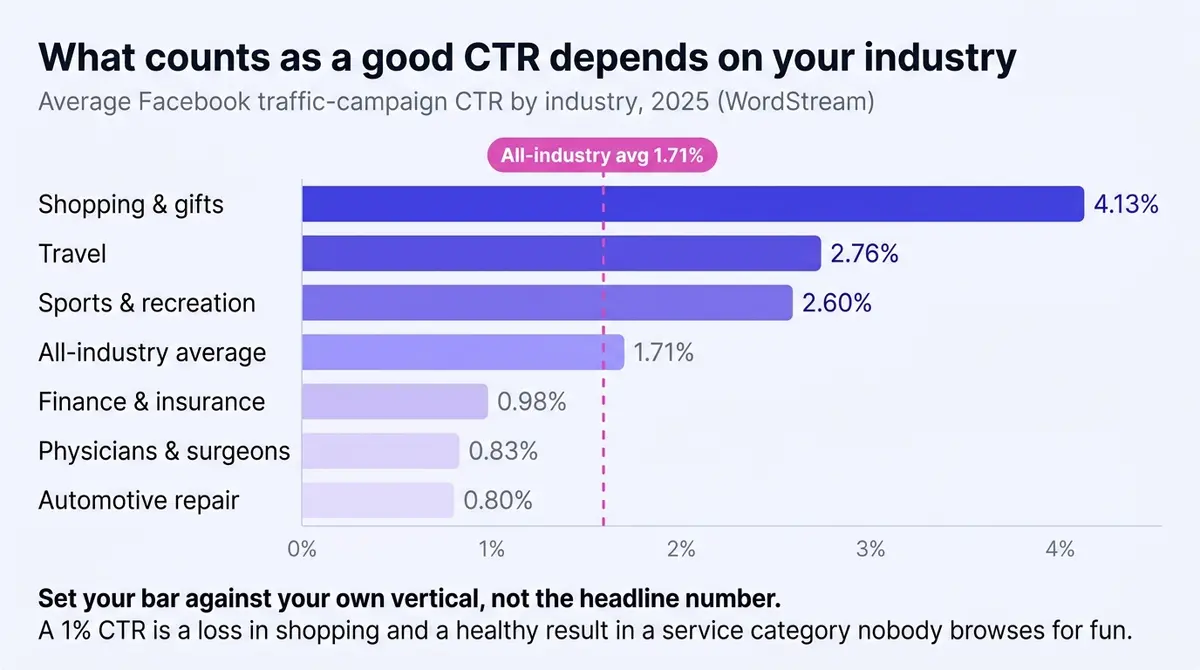
The all-industry average hides a five-fold spread. The pattern is intuitive once you see it laid out: products people enjoy looking at, like gifts and travel, earn clicks easily, while categories people only think about when something breaks or comes due, like car repair and insurance, do not. Here is where the 2025 traffic-campaign averages landed across a sample of WordStream's industries (link clicks where labelled, all-industry mix otherwise):
| Industry (traffic objective) | Average CTR (2025) |
|---|---|
| Shopping, collectibles, and gifts | 4.13% |
| Travel | 2.76% |
| Sports and recreation | 2.60% |
| All-industry average | 1.71% |
| Finance and insurance | 0.98% |
| Physicians and surgeons | 0.83% |
| Automotive repair | 0.80% |
The objective reshuffles the table again. On the leads objective, arts and entertainment averaged 3.92% and real estate 3.75%, while dentists sat at just 1.05%, all well above their traffic-campaign cousins because a lead form is a lighter ask than a click-through to buy. The takeaway for setting your own bar: if you sell skincare or home goods, hold yourself above the 1.71% average, because your category clicks easily. If you generate leads for a service nobody browses for fun, a 1% CTR with a profitable cost per lead is a win, whatever the all-industry number says.
A good CTR with a bad cost per result is still a bad ad
CTR measures exactly one thing: whether the creative earns a click. It says nothing about what the click is worth. A curiosity hook can double your CTR while filling the funnel with clickers who never buy, and the metrics that pay the bills, cost per purchase and ROAS, get worse while the CTR chart looks great.
The 2025 data makes the point at market scale. The average traffic CPC fell 6.7% to $0.70, yet Search Engine Land reported that the average Facebook cost per lead climbed 21% over the same period to $27.66. Clicks got cheaper while results got more expensive. CTR and profit are related, not identical.
The conversion rate is the layer that explains the squeeze. On the leads objective, the average landing-page conversion rate slipped to 7.72% in 2025 from 8.67% the year before (WordStream, 2025), even though the leads CTR held essentially flat at 2.59%. So the same share of people clicked, but fewer of them turned into a lead once they arrived. That is why CTR alone can look healthy while your cost per result quietly worsens: the leak moved past the click. A back-of-envelope check makes the trap concrete: if your link CTR is a respectable 2% but only 7 in 100 of those clickers convert, a $0.70 click costs you roughly $10 per lead before you have sold anything, and a more expensive click compounds the leak. The CTR column was never going to warn you about that.
For context, here is how the 2025 averages stack up across the metrics that actually decide whether a click pays:
| Metric (2025 averages) | Google Search | Source | |
|---|---|---|---|
| Click-through rate | 1.71% (traffic) | 6.66% | WordStream, 2025 |
| Cost per lead | $27.66 | $70.11 | Search Engine Land, 2025 |
| Leads conversion rate | 7.72% | n/a | WordStream, 2025 |
The punchline the CTR comparison alone hides: Facebook clicks are less frequent and lower-intent than search clicks, but the leads they produce cost roughly 60% less. Facebook's average cost per lead rose 21% to $27.66, yet that is still far below Google's $70.11 (Search Engine Land, 2025). A sub-2% social CTR is not a problem to fix, it is the normal price of interrupting a feed instead of meeting demand already in motion, and it can still run a profitable funnel because the click was cheap to begin with.
So read CTR as the diagnostic layer under your cost per result, not as the scoreboard. A healthy CTR with a bad cost per result points at the offer, the price, or the landing page. A low CTR points at the creative itself.
What actually moves CTR
Before you change anything, it helps to know which levers exist. Four things decide where your CTR lands, roughly in order of how much control you have:
- The creative. The hook, the offer on the image, the first line of text. This is the lever with the most room to move and the one you fully own, which is why the rest of this article keeps returning to it.
- Relevance to the viewer. An ad shown to the right person clicks; the same ad shown to the wrong one does not. Meta judges this in real time and grades you on it (see below).
- Format and placement. A native vertical video and a recycled landscape image earn different attention, and a Feed slot does not click like an Audience Network banner. Both quietly shift your blended CTR even when the message is identical.
- Competition in the auction. When more advertisers chase the same feed, attention thins and your CTR can slide without you touching the ad, especially in peak retail windows.
Targeting is conspicuously absent from that list, and that is deliberate. Meta automates more of the audience decision every year, so for most accounts the audience is no longer the variable you tune to lift CTR.
How Meta grades your ad's relevance
Meta does not publish your CTR percentile, but it does tell you how your ad stacks up against rivals competing for the same people. Inside Ads Manager, every ad with enough delivery gets three Ad Relevance Diagnostics, each marked Above Average, Average, or Below Average: Quality Ranking (perceived quality versus competing ads), Engagement Rate Ranking (expected engagement versus competing ads), and Conversion Rate Ranking (expected conversion versus ads chasing the same objective). These three replaced the old single Relevance Score back in 2019, and the split is the point: it tells you where the problem sits.
Read them together. A Below Average Quality and Engagement Ranking is a creative problem, the same diagnosis a low CTR gives you, so the fix is a new hook. Strong Quality and Engagement but Below Average Conversion Ranking points past the ad to the landing page or the offer. A low CTR is the symptom you see in the column; a Below Average ranking is Meta showing you why it is throttling delivery and charging you more for it.
Format and placement: two structural factors
Two structural factors move CTR before you write a single word of copy. The first is format. Short vertical video tends to stop the scroll in the feed and in Reels, a single strong image is the fastest to make and iterate, a carousel suits multi-product and step-by-step stories, and a collection turns the ad into a mini storefront. No format wins on link CTR by default, and be wary of any source that claims one always beats another on Meta: the benchmark reports that publish a single all-industry CTR do not split it cleanly by creative type, and what wins is account-specific. It is still worth knowing what the field around you is built from: a study of 679,800 Malaysian ads found video at 45% of the feed and static images at 37%. That describes the scroll your ad lands in, not which format will win in your account. Run two or three formats head to head in one ad set and let link CTR and cost per result decide.
Meta does publish one number worth keeping in mind while you set up that test. For direct-response campaigns, its newsroom reports that Reels ad sets including vertical sound-on video creative earned 5.1% higher click-through rate, 4.8% lower cost per action, and 2.9% higher conversion rate than other types of video (Meta for Business, 2025). Read it for what it is. Meta is promoting its own surface, the lift is single-digit rather than transformative, and it compares one video style against other video, not against every format. The honest takeaway is not "switch everything to Reels", it is that native vertical, sound-on creative is a sensible default to build and a strong thing to test, because the platform's own data says the format earns its slot. The conclusion is still the same: test it head to head in your own account, because a 5% format lift will not rescue a weak hook.
The second is placement. With Advantage+ placements on, one ad runs across Facebook Feed, Instagram Feed, Reels, Stories, Messenger, and the Audience Network, and Meta shifts spend toward whatever delivers. Those surfaces do not click alike. Feed and Reels, where people are leaning in, structurally earn higher engagement, while the Audience Network and right-column slots, the third-party banners and screen edges people barely register, earn the lowest. So when a benchmark moves, check the placement split before you blame the creative: a CTR dip can be Meta simply shifting impressions to a cheaper, lower-clicking surface.
How Facebook CTR compares across platforms
"Is 1.71% any good?" gets clearer when you see the neighbours. WordStream's 2025 data puts the all-industry CTR for Google Search Ads at 6.66%, several times Facebook's traffic average, because search catches people already typing what they want while a Facebook ad interrupts a scroll. That gap is structural, not a verdict on your creative. Instagram sits in roughly the same band as Facebook because both run through Meta's single auction, and TikTok figures swing too widely across formats and sources to pin to one number. The honest framing: a sub-2% CTR is normal for interruptive social, so do not import a search-engine expectation onto your feed ads, and do not treat clearing the social bar as proof the funnel pays.
Researching what works through the Meta Ad Library
You cannot see a competitor's CTR, but you can see something nearly as useful for free. The Meta Ad Library shows every active ad a brand is running and, crucially, how long each has been live. Longevity is the tell: an ad that has run for weeks is almost certainly profitable, because no one keeps paying to serve a creative that loses money. So a brand's oldest live ads are a public shortlist of their proven angles.
Work it deliberately. Search a competitor, filter by the region you sell into and by platform, and sort your attention toward the earliest start dates. For each survivor, note the hook, the offer, and the format. Patterns across several long-runners are worth more than any single ad. You are not copying their creative; you are reading which promises their audience clicks, then testing your own sharper version of that angle against your own account.
Why a low CTR is almost always a creative problem
This guide keeps pointing you back to the hook, and that is not a hunch. The numbers behind it are strong. Citing Nielsen, Meta reports that creativity drives 56% of a campaign's sales ROI, the single largest lever ahead of brand, targeting, reach, and recency. The same page cites Google research that 70% of a campaign's success is determined by the creative (Meta for Business, 2025). Two independent studies, the same verdict: the ad itself, not the audience behind it, decides most of the outcome.
Pair that with how Meta now runs delivery. Advantage+ automates most of the audience decision, so for the typical account the people your ad reaches are no longer the variable you tune. What is left in your hands is the creative, and that is exactly the lever the research says matters most. When CTR sags, you are almost always looking at a hook problem dressed up as a targeting problem.
The relevance diagnostics confirm which it is. A Below Average Quality Ranking or Engagement Rate Ranking is Meta telling you, in its own words, that the creative is underperforming against the ads it competes with. That is your signal to write a new angle, not to re-stack audiences. Treat the diagnostics as the second opinion on the diagnosis the CTR column already gave you.
Low CTR? Fix the hook, not the audience
When CTR disappoints, the instinct is to rebuild audiences. Skip it. Because Advantage+ treats your audience inputs as suggestions and finds people algorithmically, two ad sets with different audience stacks often reach similar people, so the swap rarely moves CTR. What no audience tweak can do is rescue an ad nobody wants to click.
A low CTR is almost always a hook problem, the first thing a scroller sees: the opening seconds of a video, the focal point of an image, the first line of primary text. The fix is testing genuinely different creative angles, not recolored variations of one. Three to five distinct concepts (a customer testimonial, a problem-and-solution demo, a straight offer with the price on the image) will teach you more in a week than a month of audience swaps.
Real ad examples show what that spread looks like in practice. Skinlycious, a skincare brand, runs testimonial angles like a mum describing her daughter's forehead pimples clearing. Callaa Closet demos a magnetic shawl that slips on without pins. Sierra Kota Kinabalu skips the storytelling and puts the offer up front: a clinic chemical peel for RM99 instead of RM399. Three different promises, three different reasons to click, and each would teach you something the others cannot. If you are setting up that test from scratch, the full process is in our walkthrough of how to run a Facebook ad.
Turn the benchmark check into this week's test
Reading about averages changes nothing in your account, so close the loop today:
- In Ads Manager, add the CTR (link click-through rate) column and pull the last 30 days at the ad level, not the campaign level.
- Rank your ads. Your top quartile is your real benchmark; note what those hooks have in common.
- Flag ads where frequency is rising while CTR falls. That is fatigue, and they are due for replacement however well they once performed.
- Brief three to five new hooks built on angles you have not run yet, borrowing whatever the winners share, and put them live against the incumbents.
- Judge the test on cost per result, with CTR as the explanation for why a variant won or lost.
Repeat that cycle monthly and the benchmark question starts answering itself, because you are measuring against a steadily improving version of your own account. The teams that win on Meta are rarely the ones with one great ad; they are the ones who ship the next test fastest. If producing the variations is your bottleneck, AdPlay.ai puts ad research, AI generation, a video and image editor, and Meta launch in one place, so a new angle can be live the same week it is briefed.
By the numbers
Frequently asked questions
How do you calculate CTR for Facebook ads?
Divide clicks by impressions, then multiply by 100. An ad that earned 100 clicks on 10,000 impressions has a CTR of 1%. Ads Manager calculates this for you in two columns: CTR (link click-through rate) counts only clicks through to your destination, while CTR (all) counts every click on the ad. Run the same arithmetic for either one, just feed it the matching click count. The denominator is always impressions, not reach or people, so a high-frequency ad shown many times to the same people can post a lower CTR than its reach suggests.
What is the average CTR for Facebook ads?
Across WordStream's 2025 benchmark data, Facebook traffic campaigns averaged a 1.71% CTR and lead campaigns averaged 2.59%. The spread by industry is wide: traffic-campaign averages ran from 0.80% for automotive repair to 4.13% for shopping, collectibles, and gifts. Compare your ads against your industry's figure and your own account history rather than the single all-industry number, and check whether a benchmark counts link clicks or all clicks before you judge yourself against it.
What is the difference between CTR (all) and link CTR?
CTR (link click-through rate) is link clicks divided by impressions: the share of people who clicked through to your website or destination. CTR (all) divides every click on the ad by impressions, including reactions, comments, see-more expands, and profile clicks, so it always reads higher for the same ad. Use link CTR to judge whether creative is driving traffic, and CTR (all) as a rough engagement read. When comparing against a published benchmark, make sure you are looking at the same metric.
Which format earns a higher CTR: image, video, or carousel?
There is no fixed winner across image, video, and carousel, and any blog claiming one format always beats another for Facebook link CTR is overstating it. Meta does publish one directional figure: for direct-response campaigns, Reels ad sets using vertical sound-on video creative earned 5.1% higher CTR, 4.8% lower cost per action, and 2.9% higher conversion rate than other types of video (Meta for Business, 2025). Read it as a reason to default to native vertical, sound-on creative, not as proof that switching formats fixes a weak hook, since it is Meta promoting its own surface and the lift is single-digit. The reliable move is still to run two or three formats against each other in the same ad set and let link CTR and cost per result pick the winner.
How can I see what is working for my competitors?
You cannot see a competitor's CTR; that data is private. You can see which of their ads are running and how long they have been live, which is a strong proxy for performance, in the free Meta Ad Library. Search a brand, filter by region and platform, and note the ads that have run for weeks: those are the ones earning their keep. Read the hook, the offer, and the format, not the visuals alone. An ad that has been live for two months is teaching you which angle their audience clicks.
Is a low CTR a creative problem or a targeting problem?
Almost always creative. Citing Nielsen, Meta attributes 56% of a campaign's sales ROI to the creative, and Google research puts 70% of a campaign's success on the creative (Meta for Business, 2025). Add that Advantage+ now automates most audience decisions and the hook, offer, and first line move CTR far more than re-stacking audiences ever will. Diagnose with the relevance rankings: a Below Average Quality or Engagement Ranking confirms a creative fix, so reach for a new angle rather than a new audience.
How does Facebook's cost per lead compare to Google's?
Facebook is far cheaper for leads. In 2025 its average cost per lead rose 21% to $27.66 but still came in roughly 60% below Google's $70.11 (Search Engine Land, 2025). Set that against the CTR gap, where Google Search Ads average 6.66% versus Facebook's 1.71% on traffic (WordStream, 2025): Facebook clicks are less frequent and lower-intent, but the leads they produce cost much less. That is why a sub-2% social CTR can still run a profitable funnel, the clicks were cheap to buy in the first place.
Should I optimize for CTR or cost per result?
Cost per result. CTR is a diagnostic that tells you whether the creative earns attention; cost per purchase or cost per lead tells you whether the ad makes money, and the second is the one to scale or kill on. Use CTR to explain a bad cost per result: a low CTR points at the hook, while a healthy CTR with poor conversion points at the landing page or the offer. Never chase CTR by baiting clicks that do not convert.
Sources
- 1.WordStream, Facebook Ads Benchmarks 2025 (2025)
- 2.LocaliQ, Facebook Advertising Benchmarks (2025)
- 3.Search Engine Land, Facebook Ad Costs in 2025 (2025)
- 4.WebFX, Meta Marketing Benchmarks for Facebook and Instagram (2025)
- 5.Meta for Business, Reels Ads Performance Updates (2025)
- 6.Meta for Business, High-Quality Creative Increases Ad ROI (2025)
- 7.DataReportal, Essential Facebook Stats and Trends (2025)
- 8.WordStream, Google Ads Benchmarks 2025 (2025)
- 9.Meta Business Help Center, About Ad Relevance Diagnostics (2025)
- 10.Meta for Business, Advantage+ Placements (2025)
Keep exploring
Turn ad research into winning ads
Research the ads that work, generate the creative on-brand, and launch to Meta, all in one tool.
7-day free trial · No credit card required