
Module 1 · Know your market
Reverse-engineer a winning ad in 5 parts
Take one long-running ad apart in five parts: hook, offer, proof, format and call to action. Then rebuild it for your own product, step by step.
Updated November 2026 · AdPlay.ai Team
Pick one ad that has run for more than 30 days and take it apart in five parts: the hook, the offer, the proof, the format and the call to action. Write each part as one plain sentence. Then keep the structure and replace every detail with your own product, proof and offer. You copy why it works, never the words or pictures.
Lesson 1.4 · 6 min read
Pick one ad, not a whole brand
Fifty ads give you a feeling. One ad taken apart gives you a plan.
Pick one ad from your swipe file that passes three tests:
- It has run for more than 30 days.
- It comes from a seller about your size, in your market.
- The brand runs the same idea in more than one version.
Remember what you cannot see. For a normal product ad, Meta shows no spend, clicks or sales (Meta Transparency Center). A long run is a strong clue, not proof. That is why you test your version before you spend big on it.
Part 1: the hook
The hook is whatever makes a person stop scrolling. Find it first, because nothing else in the ad matters if nobody stops.
- On a picture ad, it is the first line of the post text, plus the big words or the main image.
- On a video, it is the first frame and the first few seconds. Meta's own advice is that great Reels land the hook within the first few seconds (Social Media Today). Watch it once with the sound off too.
Feed text folds behind "See more" after a few lines. Sprout Social lists 50 to 150 characters of text for a Feed picture ad (Sprout Social, 2025). So the real hook is the first line, the part people see before the fold.
Name the type of hook, not the words. Common types: a problem ("Tired of..."), a result, a question, a number, a price, or something odd that makes you curious. The type is what you can reuse.
Part 2: the offer
The offer is what the buyer gets for their money, and what makes saying yes feel safe. Write it as one line: "X for RM Y, plus Z."
Look for:
- The price, and whether it is shown at all.
- A bundle or a set ("3 jars for RM 45").
- Free delivery, often above a minimum spend.
- Cash on delivery or another way to lower the risk.
- A deadline, if it is a real one.
Then ask which fear the offer removes. Free delivery removes "too expensive in total". Cash on delivery removes "will they send it?".
Part 3: the proof
Proof answers "why should I believe you?". Note which kind the ad uses:
- Reviews or customer messages.
- A number sold or a number of customers.
- A result the buyer can see.
- A face: the owner, a customer or a known person.
- A certificate, such as halal, where it applies.
Your version needs your own proof of the same kind. If you do not have it yet, that is your next job, not something to make up. Malaysia's Content Code expects you to hold proof for any factual claim before the ad runs (Content Code 2022, paragraph 4.8). Before and after pictures have their own rules too. See Malaysian ad rules before you publish.
Part 4: the format
Write down the shape of the ad:
- Type: one picture, a carousel or a video.
- Size: square or 4:5 for the feed, tall 9:16 for Stories and Reels (Sprout Social, 2025).
- Layout: where the product sits, how much text is on the picture, and whether you can read it in one second on a phone.
Notice if the same idea runs as both a feed picture and a tall video. That is another sign the idea works.
Part 5: the call to action
The call to action is the button and where it goes. Note both:
- The button: Shop Now, Send Message, Learn More, Sign Up.
- The page after the click: a product page, WhatsApp, a lead form.
Then click through, if the ad is still live. Does the page repeat the ad's promise and show the same offer? A winning ad and its page tell one story. If the page is a plain homepage, the ad may be winning despite it.
Worked example: one sambal ad, taken apart
Say you sell homemade sambal online at RM 18 a jar. The best ad in your swipe file is from another small seller and has run for three months.
| Part | What their ad does | Your version |
|---|---|---|
| Hook | Close-up of sambal on hot rice. First line: a question about missing home cooking | Your sambal on rice, your own question about busy weeknights |
| Offer | 3 jars for a bundle price, free delivery in the Klang Valley | Your 3-jar bundle at RM 45, delivery in your own area |
| Proof | Screenshots of customer orders on WhatsApp | Your own customer messages, shared with their permission |
| Format | One 4:5 picture, little text | A 4:5 picture, plus a 9:16 version for Stories |
| Call to action | Send Message, opens WhatsApp | Send Message, opens your WhatsApp |
The structure is theirs to learn from. Every detail in the right column is yours.
Do it in AdPlay.ai
- Open the ad in Saved Ads or the Ad Library. The Details tab shows Published, Run Time, Format, Themes, Platform and Landing Page. Video ads with speech also have a Script tab.
- Themes shows what kind of ad AdPlay.ai thinks it is, such as Testimonial or Discount or Offer. Treat it as a first guess and name the angle yourself.
- Write your five lines in the ad's Comments tab, so your team can see them.
- Click Create similar image ad (it shows on picture and carousel ads). Pick your product and settings. In What should change?, write your offer and proof, for example "lead with our 3-jar bundle at RM 45, use a customer message as proof". Click Create Your Version.
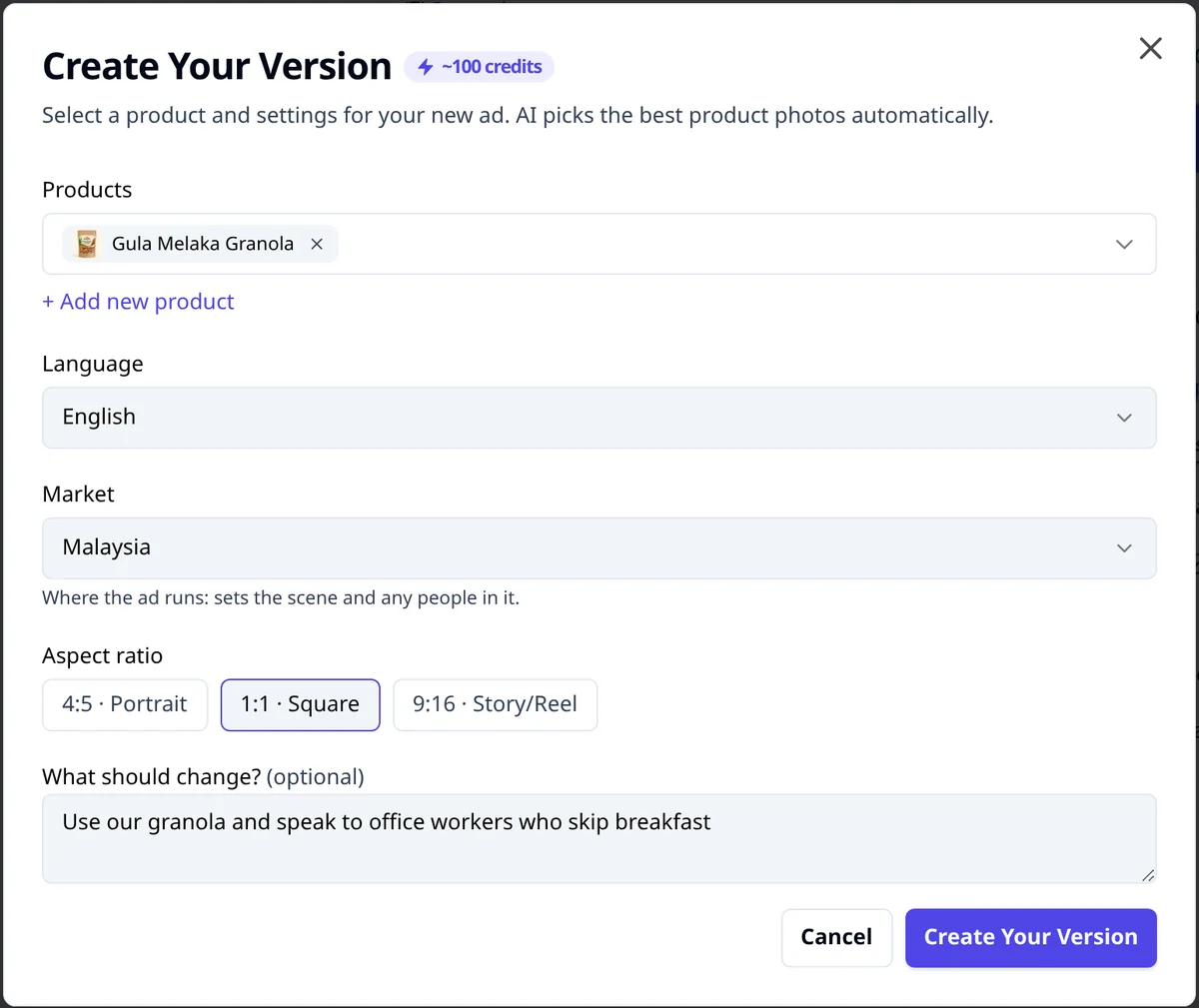
The window shows the price, about 100 credits. On the free trial, it counts as one of your 2 trial ads. After those, it needs a paid plan. The Copy a winning ad guide has the full steps.
Checklist
- One ad, run for more than 30 days, from a seller your size.
- Hook type named, not only the words copied down.
- Offer written as "X for RM Y, plus Z".
- Proof you have yourself, of the same kind.
- Format and size noted for feed and Stories.
- Button and landing page checked.
Your homework
Take apart one ad from your swipe file that has run for more than 30 days. Write its five parts, one line each, and the "your version" line beside each. Then make your version with Create similar image ad in AdPlay.ai.
This ends the module. In the next module, you turn what you learned into an offer and an angle of your own, starting with What makes you different.
Frequently asked questions
Which ad should I reverse-engineer first?
One that has run for more than 30 days, from a seller about your size, in your own market. A long run from a small seller is the best sign that the ad sells. Skip big brands' awareness ads, which can run for months without selling much.
Can I copy a competitor's ad if it works?
Copy the structure, not the ad. A problem hook, a bundle offer and a review as proof belong to nobody. The words, photos, video and logo belong to the brand, and Meta's ad rules do not allow ads that infringe someone else's copyright or trademark.
What if the ad's claim is something I cannot prove?
Then leave it out. In Malaysia, you are expected to hold proof for a factual claim before the ad runs. Our lesson on Malaysian ad rules covers what you can say.
Sources
- 1.Meta Transparency Center: Ad Library tools (2026)
- 2.Sprout Social: Facebook ad sizes and specs (2025)
- 3.Social Media Today: Meta shares tips on Reels hooks and creative (2025)
- 4.Content Forum: The Malaysian Communications and Multimedia Content Code 2022 (2022)
- 5.Meta Advertising Standards: Copyright and trademarks (2026)
Keep exploring
Turn ad research into winning ads
See what 16,000 Malaysian brands advertise, then generate on-brand creative, all in one tool.
7-day free trial · No credit card required