
Malaysian Marketing Calendar 2026: Key Dates
Every 2026 date that moves Malaysian retail: Thaipusam, CNY, Raya, Merdeka, Deepavali, the X.X mega sales, Black Friday, school holidays and payday, plus when to start creative.
Updated August 2026 · Xanny Lee, CEO

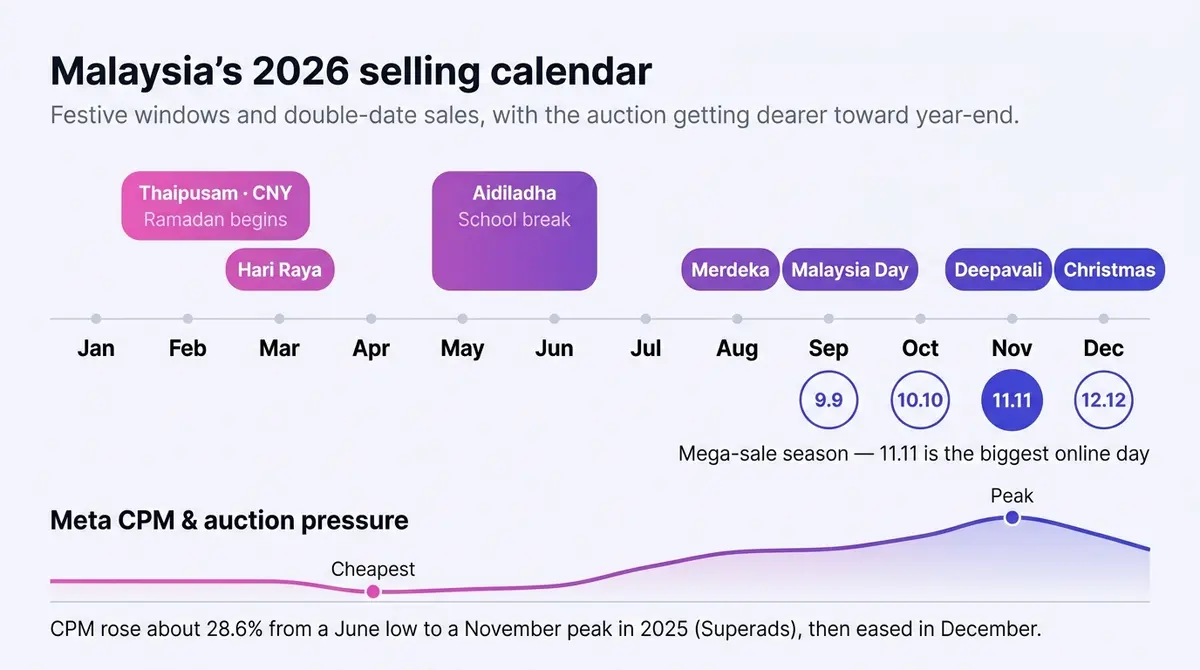
Malaysia's 2026 marketing calendar turns on seven festive windows and twelve double-date mega sales: Thaipusam on 1 February, Chinese New Year on 17-18 February, Ramadan from 19 February into Hari Raya Aidilfitri on 21-22 March, Hari Raya Aidiladha on 27 May, Merdeka on 31 August, Malaysia Day on 16 September, Deepavali on 8 November, and Christmas, with 9.9, 10.10, 11.11, and 12.12 the heavyweight sales. The spend goes to brands that move early: Malaysian retail sales rose 26% in the final two weeks of Ramadan 2025, per Criteo commerce data, and the wider market is forecast at MYR161.8 billion in 2026 (GlobalData). Start creative 6-8 weeks before each peak, and treat the Islamic dates as movable by a day until moon sighting confirms them.
The expensive half of Malaysia's retail year is still ahead. Chinese New Year and Raya have run, but Merdeka, Deepavali, Christmas, and the 9.9 through 12.12 mega sales all land in the next six months, and every one of them rewards the brand that starts creative earliest. Malaysian demand is unusually plannable: the festive windows are known a year out, the double-date sales repeat on the same twelve days, and payday lifts conversions at the end of every month. What follows is the full 2026 map, window by window, with what sells in each, the angles that fit, and the date the creative work actually needs to start.
The 2026 calendar at a glance
2026 compressed the country's two biggest buying seasons into a single week: Chinese New Year fell on 17-18 February and the first day of Ramadan followed on 19 February. That collision set the tone for the year. Windows arrive faster than production schedules expect, and the brands that win each one finished their creative while everyone else was still briefing.
| Month | What lands | Lead time (brief by) | Creative that should already be moving |
|---|---|---|---|
| January | 1.1 sale, CNY ramp, payday | CNY briefed Nov; Raya by early Jan | CNY assets live; first Raya wave in production |
| February | Thaipusam (1), 2.2, CNY (17-18), Ramadan begins (19) | Thaipusam by mid-Dec; Raya by early Jan | Raya campaigns go live as fasting starts |
| March | 3.3, Hari Raya Aidilfitri (21-22) | Aidilfitri by mid-Jan | Raya sell-through; post-Raya clearance briefs |
| April | 4.4, post-Raya lull | Test now for 9.9 | Cheapest testing window of the year |
| May | 5.5, school break (from 23 May), Aidiladha (27 May) | Aidiladha and travel by early Apr | Travel, korban and family campaigns |
| June | 6.6, school break (to 7 June) | Merdeka and 9.9 by mid-July | Brief Merdeka and 9.9 now |
| July | 7.7 | 11.11 and Deepavali by early Sep | Produce 9.9; finalise Merdeka assets |
| August | 8.8, Merdeka (31 Aug) | 9.9 already approved | Merdeka promos live; 9.9 ads approved |
| September | 9.9, Malaysia Day (16 Sep) | Brief 11.11, Deepavali, BFCM now | Mega season opens; Deepavali in production |
| October | 10.10 | 12.12 and Christmas by mid-Oct | Deepavali creative live; 11.11 assets final |
| November | Deepavali (8), 11.11, Black Friday (27), Cyber Monday (30) | 12.12 already approved | Biggest sale month of the year; 12.12 ready |
| December | 12.12, school break (5-31), Christmas (25), bonuses | CNY and Raya 2027 now | Year-end clearance; start CNY and Raya 2027 |
One caveat before any of this goes into a campaign plan: Merdeka (31 August) and Malaysia Day (16 September) never move, but the Islamic dates are confirmed by official moon sighting on the eve of each event and can shift by a day. Build that day of slack into countdowns and end-date copy.
Beneath the festivals, two cycles repeat every month and give the calendar its base rhythm. Gajian, payday, lands in the last few days of the month for most salaried Malaysians, lifting conversions from roughly the 25th into the first week of the next month, and the X.X double dates sit at the top of the month to catch exactly that money. The pattern is not folklore: an academic study of card spending found daily card spend rises about 4.5 percentage points the day after payday, then dips three to four weeks later as the mental budget runs down. So every month takes the same shape: spend into the payday window, test through the mid-month lull, repeat. The audience this calendar moves is almost entirely reachable online. DataReportal's 2026 report counts 35.4 million internet users in Malaysia, 98% of the population, and 30.7 million active social media identities (85%), with Facebook ads reaching 23.0 million people and Instagram 16.1 million in late 2025. A festive campaign that gets Meta placements right covers most of the market on its own.
Why the calendar is worth the work
Every spike on this calendar sits on a large, fast-growing base, which is what makes the lead-time discipline pay off. GlobalData forecasts Malaysia's ecommerce market at MYR161.8 billion in 2026, up 9.4% on the year, decelerating from a 13.4% rise in 2025 but still expanding faster than most of the region's mature markets. The growth is concentrated in exactly the windows below. Momentum Works put Malaysia's platform GMV growth across 2025 at 47.6% year on year, the second-fastest in Southeast Asia, and the festive months do the heavy lifting: one trade tracker put Shopee Malaysia's sales rising from about RM54 billion in February 2025 to roughly RM60 billion in March, the Raya month, an 11% jump on fashion, home goods, and festive food, with TikTok Shop's Malaysian sales reported to have nearly doubled across the same stretch (figures from a trade outlet's scraped estimates, directional rather than audited). A brand that lands its creative early is not chasing a one-day blip. It is positioning for the heaviest spending weeks of a market adding tens of billions of ringgit a year.
Q1: Thaipusam, then Chinese New Year straight into Ramadan
The year opens with a window many brands skip. Thaipusam fell on Sunday 1 February 2026, gazetted nationally that day alongside Federal Territory Day, and observed as a public holiday in Kuala Lumpur, Putrajaya, Selangor, Penang, Perak, Negeri Sembilan, and Johor (seven states do not observe it, so treat it as a regional, not national, window). For Indian-Malaysian audiences it is a real buying moment: gold and jewellery, prayer items and pooja supplies, new clothing, and travel to Batu Caves for the kavadi procession. The angles that fit are devotional and family-led, not discount-led, and the audience is geographically concentrated, so target the observing states rather than the whole country. Thaipusam sits just over two weeks before Chinese New Year, so a brand serving both communities is effectively running two Q1 campaigns back to back, and the Thaipusam creative needs briefing by mid-December to clear review in time.
On paper the rest of the first quarter holds two more festive seasons; in practice 2026 ran them together. Reunion dinner fell on 16 February, then fasting from Thursday 19 February, so hamper, mandarin orange, and gifting demand ran right up against the first baju raya drops and the kuih raya pre-orders that bakery and dessert advertisers build their year around. Any brand serving both markets needed two finished campaigns by early January.
The Raya window rewards the early mover more than any other. Purchases start with Ramadan day one, not Raya week: sedondon family sets sell through early, home-refresh and kitchen categories build across the month, and the spike compounds toward the end. Criteo commerce data reported in February 2026 put Malaysian retail sales up 26% in the final two weeks of Ramadan 2025, with a single-day peak of 52%. The angles that fit are family and homecoming: balik kampung logistics, open-house hosting, duit raya packets, matching outfits for three generations. The offers in Malaysian feeds run on the same clock: skincare brand Glad2Glow has pitched a five-piece bundle at RM58.50 squarely at Ramadan, while modest-wear seller Hijab Sarung Cantik leans on urgency with three simple Raya hijabs for RM100, today only. Both are typical of what fills the auction once fasting starts. CNY pulls the same levers with different props: prosperity, gifting bundles, the reunion table, and hard delivery cutoffs that make an order-by date a legitimate hook.
The quieter middle: Aidiladha, school break, Merdeka
April is the year's deep breath. Raya clearance aside, demand and auction competition both thin out, which makes it the cheapest stretch to test new hooks, formats, and offers while little is at stake. Hari Raya Aidiladha followed on Wednesday 27 May, a quieter window centred on the korban, travel, and food rather than gifting, and it sat inside the mid-year school break (23 May to 7 June in most states), which lifts travel, theme parks, and family dining for two weeks. Aidiladha is not a gifting peak like Aidilfitri, so the products that move are different: meat and food supplies, travel and balik-kampung essentials, modest wear refreshed for the second Raya, and homeware for guests. It rewards lighter spend and a useful angle (korban logistics, recipes, family travel) rather than a hard discount push.
What to actually do in the quiet months
The stretch from April to June is the calendar's testing lab, and "test hooks" is only useful as a method. Run it in four moves. First, clear festive overstock: a post-Raya clearance angle catches shoppers who held back, and it frees cash and warehouse space before the next build. Second, rebuild the warm pools the festive spike just filled. Every Raya buyer, site visitor, and video viewer from Q1 is a retargeting audience now, so package them into Custom Audiences and seed a fresh Lookalike off your highest-value Raya purchasers while the data is recent. Third, A/B the hooks you intend to scale at 9.9, not micro-variations: a genuinely different opening, format, or angle teaches you something a headline tweak never will, and cheap April CPMs let you read a clean result for a fraction of the festive cost. Fourth, refresh evergreen creative and your best-sellers' product pages so the always-on campaigns that carry the lull stay efficient. The point is to walk into September with proven angles and rebuilt audiences, not a blank slate.
Merdeka on 31 August and Malaysia Day on 16 September bracket a fortnight of national pride. The selling here is lighter touch: themed bundles and 31-style price promos do the work, and the best creative wears the flag with restraint. The more important August job is invisible. 9.9 opens the heaviest season nine days after Merdeka, so by the time the fireworks go up, your 9.9 creative should already be approved and scheduled.
Where the festive spend actually sits: marketplace versus own store
A festive plan is not only a calendar, it is a channel decision, and the two interact. Most Malaysian online demand at peak flows through three marketplaces. Momentum Works reported Shopee held about 53% of Southeast Asia's platform GMV in 2025, the leader in all six markets, with TikTok Shop and Lazada behind it, while TikTok Shop's Malaysian sales were reported to have nearly doubled across 2025 as live-commerce buying took hold (a trade outlet's scraped estimate, directional rather than audited). The practical reading: on a mega-sale day, the marketplaces own the discovery and the voucher stack, and shoppers compare deals across Shopee, Lazada, and TikTok Shop tabs in one sitting.
That shapes where each kind of campaign belongs. If you sell on the marketplaces, the festive job is to stack their mechanics: join the platform campaign, claim the seller vouchers, run in-app ads and TikTok lives during the sale, and let the marketplace bring the traffic. If you sell from your own store, Meta is the lever, and the move is to use the festive demand the marketplaces create without paying their take rate: run your own-store offer to a warm audience, retarget the people who browsed but did not buy, and lean on email and SMS where there is no auction at all. Most brands run both, and the deliberate version splits by intent. Marketplace for reach and deal-hunters, own store and Meta retargeting for margin and repeat buyers. Decide that split before the sale, because the budget and the creative differ for each, and a brand that treats "11.11" as a single undifferentiated push usually overspends on cold marketplace traffic it could have reached cheaper as a warm own-store audience.
The mega-sale gauntlet: 9.9 to 12.12, with Deepavali in the middle
The 9.9, 10.10, 11.11, and 12.12 sales carry most of Malaysia's online retail volume, and the platforms treat them accordingly. At the 2025 edition of 11.11, Shopee ran celebrity livestream marathons, Lazada launched an AI shopping assistant, and TikTok Shop reported over 200% year-on-year growth in brands joining its Mall program. The auction gets crowded and stays crowded. A brand that walks in with one hero ad gets outspent; the brands that do well arrive with a proven angle and a stack of variations ready to rotate.
Deepavali lands on Sunday 8 November, three days before 11.11. Jewellery and gold, sarees and ethnic wear, murukku and festive food, lamps and home decoration all peak in the fortnight before, which means Deepavali gifting campaigns and 11.11 offer campaigns share the same audiences in the same week. Brief them together.
Black Friday and Cyber Monday: the imported window
Between 11.11 and 12.12 sits a window that Western-calendar shoppers expect and many Malaysian brands ignore. Black Friday 2026 falls on Friday 27 November, with Cyber Monday on Monday 30 November. Locally, 11.11 and 12.12 still dominate the headline volume, so Black Friday is not the year's biggest day in Malaysia. It is a real and growing one, and it imports demand the double dates do not: Western-brand shoppers, electronics and tech buyers, and cross-border purchases. DHL reported that 85% of Asia Pacific businesses planned to take part in Black Friday and Cyber Monday in 2025, though only about 38% of Malaysian shoppers completely or mostly trust Black Friday pricing, so the honest, clearly-stated discount wins here even more than usual. The practical move is to treat BFCM as a four-day bridge between the two double dates rather than a separate build. Run the same warm audiences you assembled for 11.11, lead with the categories that over-index on Black Friday (electronics, gadgets, premium and imported brands), and keep the price maths transparent so a sceptical shopper trusts it at a glance.
Christmas (Friday 25 December) and 12.12 then close the year against a backdrop that favours spending: bonuses land, and the year-end school break runs 5 to 31 December, so families are mobile and gifting is universal. Treat 11.11 through 12.12 as one connected sell-through arc: the warm audience you built for 11.11 is the cheapest crowd to re-sell across Black Friday and again on 12.12, and a year-end clearance angle catches the shoppers who waited.
Run each peak in phases, against the auction
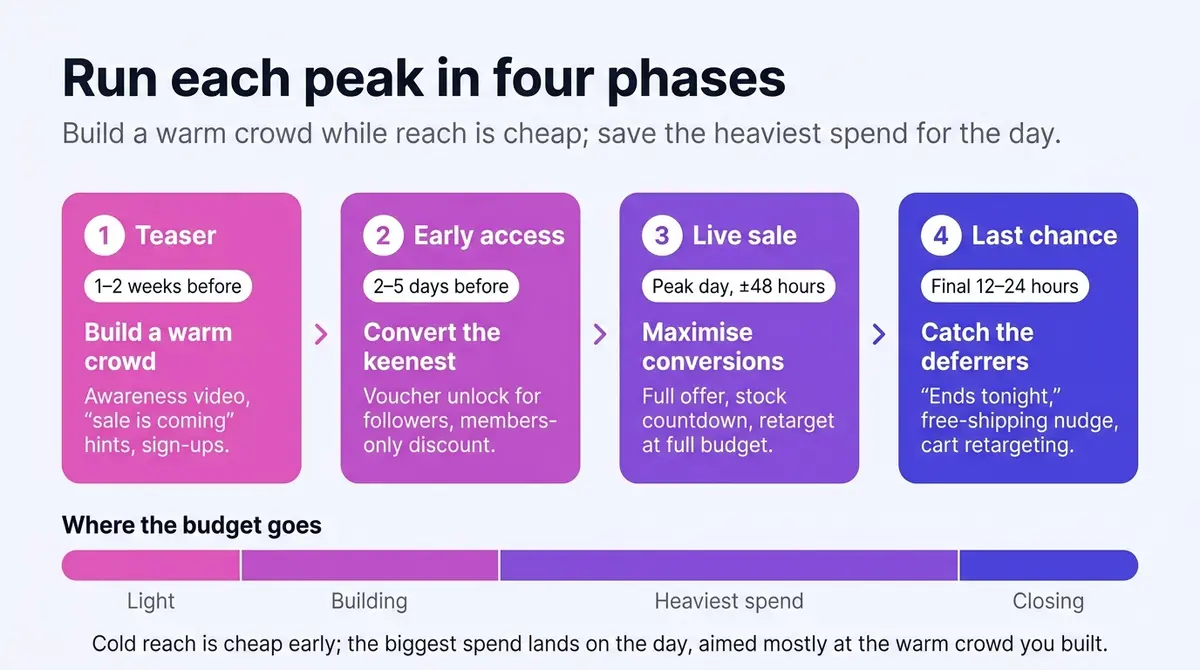
A single ad dropped on the sale day leaves most of the money on the table. The brands that clear stock run a peak as four phases, each with its own job and audience temperature, building a warm crowd while reach is cheap and saving the heaviest spend for the people who already know them.
| Phase | When | Job | What to run |
|---|---|---|---|
| Teaser | 1-2 weeks before | Build a warm crowd while reach is cheap | Awareness video, "sale is coming" hints, early-access sign-up |
| Early access | 2-5 days before | Convert the keenest buyers, seed reviews | Voucher unlock for followers, members-only discount |
| Live sale | Peak day, plus 48 hours around it | Maximise conversions at the offer's peak | Full offer, stock-countdown creative, retargeting at full budget |
| Last chance | Final 12-24 hours | Catch deferrers and cart-abandoners | "Ends tonight" copy, free-shipping reminder, cart retargeting |
The teaser phase is the one most small brands skip and most regret: reaching a cold audience for the first time on the busiest, most expensive day of the year is the worst trade in the calendar.
That is why the highest-return spend in a peak goes to people who already know you: past buyers, site visitors who did not check out, and the cart-abandoners every sale produces in volume. Cart abandonment is not an edge case; the documented average across studies sits around 70%, so two of every three carts started are left behind. A retargeting layer that follows those shoppers with the exact item they viewed, a free-shipping nudge, or a closing-soon reminder recaptures a meaningful slice of that lost intent at a fraction of cold-traffic cost.
Build those warm pools across the year, not the night before a sale: every quiet-month test and teaser phase deposits visitors and engagers you can re-sell at peak, and last year's festive buyers are the best audience for this year's same festival. Email and SMS compound the same effort for free. Let the teaser phase double as list-building, trading an early-access code or voucher for an email address or phone number, then carry the offer through a short segmented sequence: an announcement at open, a reminder to non-openers, a "last chance tonight" send, plus cart-abandon flows that reinforce the retargeting. It reaches the same people on a channel you do not pay an auction for, where a sale's quieter, more profitable revenue often hides.
Two numbers turn "the auction gets crowded" into a plan. The first is cost. Festive auction inflation is real and well documented: Superads' benchmark of aggregated ad spend put the average Meta CPM peaking around $24.21 in November 2025, about 28.6% above the $18.83 it started at in June 2025, before easing back in December. Malaysia's mega-sale calendar stacks 11.11, Black Friday, and 12.12 into the same crush, so plan for a result that costs RM10 in the quiet months to run closer to RM13 to RM14 in the festive weeks. You do not out-bid that inflation; you out-create it and lean on the cheaper warm audiences above. The second is a creative target you can read before the auction even matters: the hook rate, the share of people who saw your video and stopped to watch the first three seconds. A workable benchmark is around 25% as table stakes and 30% or higher for strong creative, so treat 30% as the floor for anything you spend real money behind, because a clip that cannot clear it in testing only burns faster at peak CPMs.
That floor is also why no peak runs on one ad. A week-long sale fatigues fast: the same person sees the same hero again and again, and attention falls off a cliff. Plan three to five distinct angles for the launch, each cut into a couple of formats and aspect ratios for feed, Reels, and Stories, then hold a second wave ready to swap in mid-sale. The signal to rotate is mechanical: when frequency climbs while click-through and return on spend slide, that is fatigue, and a fresh angle revives delivery faster than any budget change. Prove your strongest angle on a quiet double date such as 7.7 or 8.8, then walk into the festive week running creative that has already survived a real auction.
Craft the offer and the creative
The festival sets the mood; the offer mechanic is what shoppers compare across a dozen tabs. Name it before you write a line of creative, because the deal structure decides the hook.
| Offer type | Best for | Why it works in a crowded feed |
|---|---|---|
| Flat percentage off | Fashion, beauty, broad catalogues | A round 20%, 30%, or 50% reads instantly; RM amounts on mixed carts do not |
| Free gift with purchase | Beauty, supplements, food | Lifts perceived value without discounting the hero product |
| Bundle or set | Home, grooming, gifting | Raises basket size; suits sedondon and open-house buying |
| Free shipping | Anything under a high cart value | Removes the most common reason a cart is abandoned |
| Early-bird or first-N | High-demand drops | Adds a real deadline countdown copy can stand on |
Malaysian shoppers have grown wary of inflated "before" prices, so keep the maths honest and visible at a glance. A clear, believable 30% off beats a theatrical "up to 70%" that only one SKU qualifies for. The pattern worth copying looks like Nihonskin's dark scar repair kit offer: RM369 against a stated RM569, with free gifts stacked on top instead of a deeper cut nobody believes.
With the offer named, dress it for the season. Festive creative is recognised before it is read, and each window carries a colour code shoppers parse in a fraction of a second. Use the season's motif once, with restraint: a single seasonal cue reads as belonging to the moment, while a brand drowned in seasonal colour reads as a template, so keep your own colours legible underneath.
| Window | Palette that signals the season |
|---|---|
| Chinese New Year | Red and gold, with the year's zodiac (the Horse in 2026) |
| Raya (Ramadan and Aidilfitri) | Green, soft pastels, ketupat and crescent motifs |
| Deepavali | Jewel tones, gold, rangoli and lamp imagery |
| Merdeka and Malaysia Day | The Jalur Gemilang's blue, red, white, and yellow, worn with restraint |
| Christmas and year-end | Deep red, green, and metallics |
Turn the calendar into a production schedule
Put a brief date 6-8 weeks ahead of every peak you plan to contest, then treat those dates as real deadlines. The table below turns the rest of 2026 into a single ledger: to contest the window, brief by the date shown, and switch on spend from the run-from date. The lead time covers a full build (concept, creative, review, and a teaser wave); a simpler offer can compress it, but the festive windows punish a late start hardest.
| Window | Date | Brief by | Run from |
|---|---|---|---|
| Aidiladha | 27 May | early April | mid-May |
| Merdeka and Malaysia Day | 31 Aug, 16 Sep | mid-July | mid-August |
| 9.9 | 9 Sep | mid-July | late August (teaser) |
| 10.10 | 10 Oct | early September | late September (teaser) |
| Deepavali | 8 Nov | mid-September | late October |
| 11.11 | 11 Nov | early September | late October (waitlist) |
| Black Friday and Cyber Monday | 27-30 Nov | late September | mid-November |
| 12.12 | 12 Dec | mid-October | early December (teaser) |
| Christmas | 25 Dec | mid-October | early December |
| CNY 2027 and Raya 2027 | Feb 2027 onward | this December | from CNY ramp |
A quick legend for the run-from column: "teaser" means a soft awareness or early-access wave one to two weeks before the day; "waitlist" means a sign-up offer that builds a warm crowd before the auction floods. The single rule the whole table operationalises: brief 6-8 weeks out, run the teaser one to two weeks out, go hard on the day. December then does double duty, because Ramadan 2027 will begin about eleven days earlier than this year's did, so CNY and Raya production both belong in this year's December plan.
Before each brief, spend an hour looking back. Last year's winners are the cheapest research you will run: pull the festive ads that ran long and got remade, note the format, angle, and message that repeated, and use them to set this year's targets. Those winning angles are on the public record, and a searchable archive of millions of Malaysian ads, such as AdPlay.ai, makes pulling them fast. Build each campaign on an angle that already survived a festive auction, produce the variations early, and test on the small double dates before the expensive months.
One last check before the spend goes live: the ad is only half the job, and festive traffic arrives on a phone. Confirm the landing page loads fast and reads on mobile, that stock and shipping cutoffs on your best-sellers are set, and that checkout works on a real device. The cheapest way to waste a peak budget is to send a ready-to-buy crowd to a page that stalls. If the Ads Manager mechanics are the unfamiliar part, how to run a Facebook ad walks the full setup. Every competitor shares this calendar; lead time is the part you control.
By the numbers
Frequently asked questions
When is Hari Raya Aidilfitri 2026 in Malaysia?
Hari Raya Aidilfitri 2026 fell on Saturday 21 and Sunday 22 March, after Ramadan began on Thursday 19 February. Because the first day landed on a Saturday, an additional public holiday was declared, stretching the break from Friday 20 March through Monday 23 March. Islamic dates in Malaysia are confirmed by official moon sighting shortly before each event and can shift by a day from published estimates; the start of Ramadan 2026 was only confirmed on the evening of 17 February.
Should I run Black Friday and Cyber Monday in Malaysia, or do 11.11 and 12.12 already cover it?
Run it as a bridge, not a separate build. Locally 11.11 and 12.12 still carry the bigger headline volume, so Black Friday (Friday 27 November 2026) and Cyber Monday (Monday 30 November) are not the biggest days of the Malaysian year. They do import demand the double dates do not: Western-brand shoppers, electronics and tech, and cross-border buys. DHL reported 85% of Asia Pacific businesses planned to join Black Friday and Cyber Monday in 2025, though only about 38% of Malaysian shoppers completely or mostly trust Black Friday pricing, so keep the discount honest and the maths obvious. Reuse the warm audiences you built for 11.11, lead with the over-indexing categories, and treat the four days as a connected step toward 12.12.
What offers convert best on Malaysian mega-sale days?
Shoppers compare the deal mechanic, not just the festival. The reliable structures are a clear percentage off (a round 20%, 30%, or 50% reads faster than RM amounts on a cart of mixed prices), a free gift with purchase, a bundle that lifts basket size, and free shipping, which removes the most common reason a cart is abandoned. Add a real deadline: platform vouchers, an early-bird tier, or a first-100-buyers cap. Malaysians have grown sceptical of inflated before prices, so keep the discount honest and the maths obvious at a glance.
Which X.X mega sales matter most in Malaysia?
All twelve double dates from 1.1 to 12.12 produce a spike, but 9.9, 10.10, 11.11, and 12.12 carry most of the volume, with 11.11 the biggest online shopping day of the year. Shopee, Lazada, and TikTok Shop run their heaviest campaigns across that stretch; during its Malaysian 11.11 campaign in 2025, TikTok Shop reported over 200% year-on-year growth in brands participating in its Mall program. The earlier double dates work well as low-stakes months to test hooks and offers before the expensive season.
How much do ad costs rise during festive windows, and how do I budget for it?
Plan for inflation, not surprise. Meta CPMs climb into the year-end auction as advertisers crowd in: Superads' benchmark of aggregated spend put the average CPM peaking around $24.21 in November 2025, about 28.6% above the $18.83 it started at in June 2025, before easing in December. Malaysia stacks 11.11, Black Friday, and 12.12 into that same crush, so budget the same shape: hold a leaner test budget through the cheaper months, then fund the festive weeks at a higher cost per result and protect margin with the discount, not the bid. Warm-audience retargeting is your hedge, since reaching people who already know you stays far cheaper than buying cold reach at peak prices.
When is Thaipusam 2026 in Malaysia, and is it worth advertising around?
Thaipusam 2026 fell on Sunday 1 February, gazetted nationally that day alongside Federal Territory Day, and observed as a public holiday in Kuala Lumpur, Putrajaya, Selangor, Penang, Perak, Negeri Sembilan, and Johor (seven states do not observe it). For brands serving Indian-Malaysian audiences it is worth a window: gold and jewellery, prayer and pooja items, new clothing, and travel to Batu Caves all see demand around it. The angles are devotional and family-led rather than discount-led, and because the audience is geographically concentrated, target the observing states rather than the whole country. It sits just over two weeks before Chinese New Year, so brief it early enough that it does not collide with your CNY build.
When is Deepavali 2026 in Malaysia?
Deepavali 2026 falls on Sunday 8 November, a public holiday in every state except Sarawak, and because it lands on a Sunday most states observe the following Monday as a replacement holiday. For planners the date matters twice over: it sits three days before 11.11, so Deepavali gifting, jewellery, ethnic wear, and open-house campaigns share an auction with mega-sale advertisers. Brief both campaigns together and decide deliberately which audiences see which message in the first ten days of November.
How do I keep my landing page and stock ready so festive traffic converts?
Festive ads send a mobile crowd to your page, so the page has to load fast and read on a phone. A slow page bleeds the exact intent you paid peak CPMs to buy: compress hero images, cut heavy scripts, and test the checkout on a real phone before the sale. Then handle the top reason a ready buyer still walks: Baymard Institute puts average cart abandonment at about 70% across 50 studies, with unexpected extra costs at checkout the single most-cited reason, so show free-shipping thresholds and any fees up front rather than at the final step. Confirm stock and shipping cutoffs on your best-sellers, and pause ads for any product that sells out so you stop paying to send traffic to an out-of-stock page.
Sources
- 1.Office Holidays, Malaysia Public Holidays 2026 (2026)
- 2.The Star, Thaipusam and FT Day Gazetted as Public Holiday on Feb 1, 2026 (2025)
- 3.SAYS, These 7 States Will Not Observe a Thaipusam Public Holiday on 1 February 2026 (2026)
- 4.Smart Trade Hub Solutions, 2025 March Malaysia Ecommerce Scene (2025)
- 5.Gulf News, Ramadan 2026: Malaysia Confirms First Day of Holy Month (2026)
- 6.DataReportal, Digital 2026: Malaysia (2026)
- 7.GlobalData, Malaysia Ecommerce Market to Register 9.4% Growth in 2026 (2026)
- 8.Momentum Works, Southeast Asia's Platform Ecommerce Reaches US$157.6B in 2025 (2026)
- 9.eCommerce News Asia, Ramadan 2025 Reshapes Southeast Asia Shopping Journeys (2026)
- 10.Marketing-Interactive, Malaysia's 11.11 Showdown (2025)
- 11.Media OutReach Newswire, DHL: Asia Pacific Retailers Optimistic for Black Friday and Cyber Monday (2025)
- 12.KPM 2026 Academic Calendar via CutiSekolah, Malaysian School Holidays 2026 (2026)
- 13.Superads, Facebook Ads CPM Benchmarks (2026)
- 14.ScienceDirect, Present Bias, Mental Budget Constraint, and the Payday Consumption Cycle (2024)
- 15.Vaizle, Hook Rate and Hold Rate: Facebook Ads Formulas and Benchmarks (2025)
- 16.Baymard Institute, Cart Abandonment Rate Statistics (2026)
Keep exploring
Turn ad research into winning ads
See what 16,000 Malaysian brands advertise, then generate on-brand creative, all in one tool.
7-day free trial · No credit card required