
Module 3 · Make the ads
Choose three angles, not three versions
Why your first test should be three different reasons to buy, not three colours of one ad. How to pick the three angles, with a Malaysian worked example.
Updated November 2026 · AdPlay.ai Team
Your first Meta ads test should compare three different angles, meaning three different reasons to buy, not three versions of one ad. Different angles reach different people and teach you what your buyers care about. Pick one angle that is already proven in your market, one built on your own difference, and one from an offer or an occasion.
Lesson 3.2 · 5 min read
You have a list of ideas from the last lesson. The tempting move is to take the one you like best and make three versions of it: red background, blue background, a different photo. Then you run them and learn almost nothing, because all three say the same thing.
This lesson shows a better first test: three angles.
Angle or version?
An angle is the reason someone should buy. A version is the same reason, dressed differently.
- "Dinner in 10 minutes" and "Dinner in 10 minutes" on a blue background are two versions of one angle.
- "Dinner in 10 minutes" and "A gift your family will actually use" are two angles.
A quick test: swap the headlines of two ads. If both ads still make sense, they are versions. If the swap breaks them, they are different angles.
Why different angles win the first test
The angle is the lever you control. Across nearly 450 sales studies, NCSolutions found that creative drove about 49% of a campaign's extra sales, against about 11% for targeting (reported by Westwood One, 2024). Your angle is the core of your creative.
Meta matches different ads to different people. Meta's ad delivery system picks which ad each person sees from many candidates (Meta Engineering described its Andromeda retrieval system in December 2024). Three ads that say the same thing give it little to choose from. Three different reasons to buy let it show the speed angle to a busy parent and the gift angle to someone shopping for Raya.
You learn what your buyers care about. When one angle wins clearly, you know what to make more of. When three versions of one angle run, you only learn which colour got lucky. The Meta Andromeda guide explains the delivery side in depth.
A small budget can only feed a few ads. Meta's help pages say an ad set usually needs about 50 optimisation events in 7 days to leave the learning phase. Every ad you add shares that budget, so each one gets less spend. Three ads is enough to learn and few enough to fund. The campaign structure lesson allows up to five, and Budget and the learning phase covers the numbers.
How to pick your three
Use one slot for each source:
- The proven angle. One idea built on a pattern that has run for months in your market. This is your safe bet.
- Your difference. One idea built on what only you can say: your recipe, your service, your guarantee. This is where you stand out.
- The offer or the occasion. One idea built on a deal (a bundle, free delivery) or a moment (Raya, payday, back to school). This one often brings fast sales.
Then check the three against each other:
- Each angle fits in one sentence that starts with a different reason.
- Each speaks to a buyer you actually have.
- You can prove each claim.
- The price is the same in all three, unless the offer is the angle.
A worked example
Back to the home sambal business in Ipoh. From the ideas list, you pick:
| Slot | Angle | Hook on the image |
|---|---|---|
| Proven | Home-made taste with no cooking time | "Dinner in 10 minutes." |
| Your difference | Made in small batches from your grandmother's recipe | "Still made by hand, 40 jars a day." |
| Offer | Stock up and save on delivery | "3 jars for RM 45. Free delivery." |
You drop two other ideas: "spiciest sambal in Perak" (you cannot prove it) and a second speed idea (it is a version of the first).
The "40 jars a day" line only works if it is true. If you make 60, say 60.
After a week, say the offer ad gets orders at RM 9 each, the speed ad at RM 14 and the recipe ad at RM 25. You now know your buyers respond to value first. The next round makes more value ads, and later tests one change at a time (see Test one change).
These are made-up numbers for the example. Your own will be different.
Doing it in AdPlay.ai
On the Ideas step of the Ad Generator, the tags help you spread your picks:
- Read the tag on each idea. Ideas with different tags (Winning pattern, Competitor gap, Fresh angle, House style) usually come from different reasons.
- Open Details › and read the Angle line. Pick three ideas whose angles fail the headline swap test.
- Click Add to selection on each. If the offer is one of your angles, click Add proof or offer and type it, so the ad uses your real price.
- Click Generate 3 ads. If an idea is built on a review, a number or an offer you have not confirmed yet, a short check opens first. Each image ad uses about 100 credits.
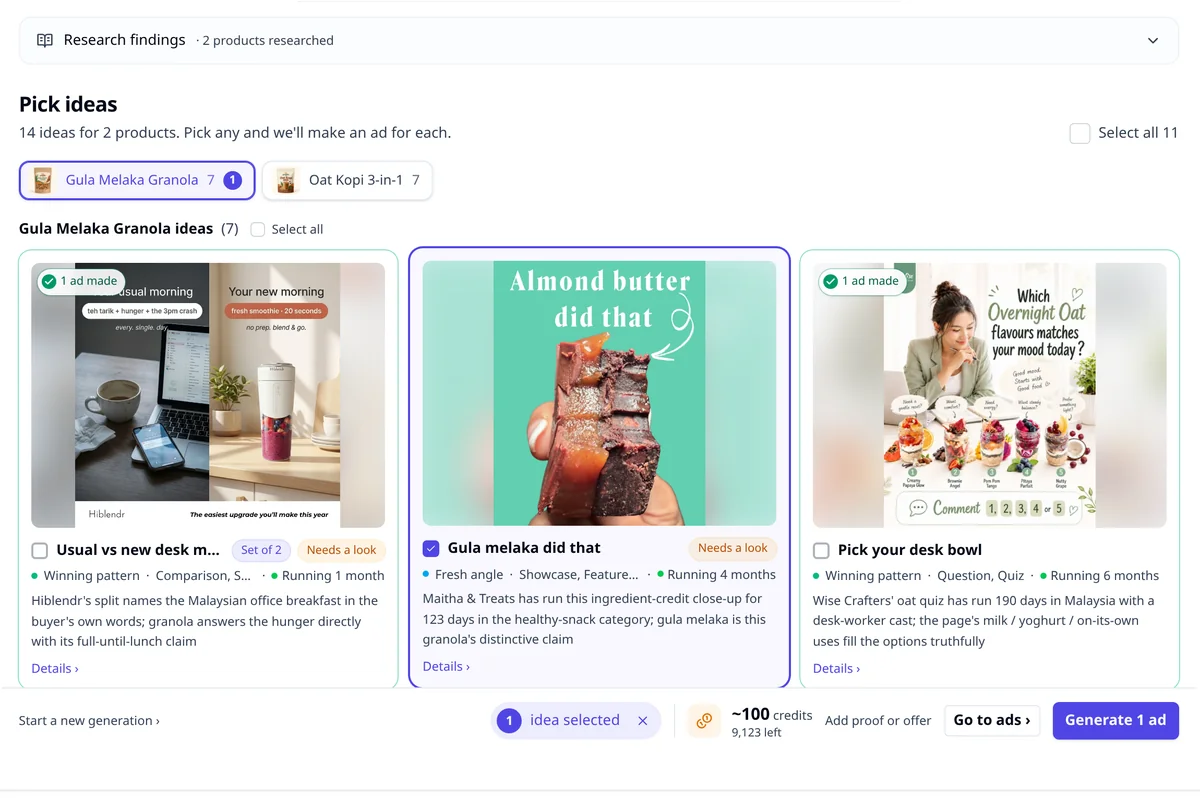
On the free trial you can make 2 image ads, so start with two angles and add the third on a plan. Later, when one angle wins, Create variant makes a new ad with the same layout and one change. That is for testing versions, after this lesson's test. See Create variant.
Checklist
- Three ads, three different reasons to buy.
- One proven, one your difference, one offer or occasion.
- Same price in all three, unless the offer is the angle.
- No claim you cannot prove.
Your homework
Write your three angles as three sentences, each starting with a different reason ("Because it saves time...", "Because only we...", "Because this week..."). Then pick one idea for each on your Ad Generator ideas board and make the ads. Keep the three sentences. You will judge the results against them in module 5.
Frequently asked questions
Why three angles and not five or ten?
Three is the smallest test that still compares reasons to buy, and it suits a small budget. Each ad needs enough spend to show a result. If your budget allows, the campaign structure lesson puts 3 to 5 ads in a test, as long as each one has a different angle.
When should I test versions of one ad instead?
After you have a winning angle. Then you test one change at a time, such as a new hook or a new photo, to make the winner better. That is the job of a later lesson, Test one change.
Should all three angles use the same offer?
Keep the price and offer the same in your first test unless the offer is the angle. If one ad says RM 15 and another says 3 for RM 45, you will not know whether the angle or the price made the difference.
Sources
Keep exploring
Turn ad research into winning ads
See what 16,000 Malaysian brands advertise, then generate on-brand creative, all in one tool.
7-day free trial · No credit card required