
Module 3 · Make the ads
From market research to ad ideas
Turn the winning ads in your market into clear ad ideas: who each one is for, the angle, the hook and the picture. Worked example, checklist and homework.
Updated November 2026 · AdPlay.ai Team
An ad idea is more than a nice picture. A usable idea names who the ad is for, the reason to buy (the angle), the first words people see (the hook) and what the picture shows. Build each idea on an ad that has already run for a long time in your market, then check you can prove what it says before you make it.
Lesson 3.1 · 5 min read
Most small businesses start an ad with a picture: a nice photo of the product and a price. Then they wonder why it gets likes but no orders. The fix comes before the picture. You need an idea, and the best ideas come from ads that are already working in your market.
This lesson shows how to turn what you found in the Ad Library (module 1) into ideas you can make this week.
What a usable ad idea looks like
An idea is ready to make when you can fill in four lines:
- For: who the ad speaks to. "Office workers in Klang Valley who cook dinner after 7pm", not "everyone".
- Angle: the reason to buy, in one sentence. "Dinner tastes home-made in 10 minutes."
- Hook: the first words people read on the image. "Nasi lemak night, no pounding."
- Visual: what the picture shows. "A jar being spooned over hot rice, steam rising."
If one line is empty, the idea is not ready. A picture with no angle is decoration. An angle with no buyer speaks to nobody.
Where ideas come from
Good ideas rarely come from a blank page. They come from three places:
- A pattern that already works. In the Ad Library, an ad that has run for months is one a business keeps paying for, which usually means it sells. Ask what that ad promises and who it talks to. You learned to read these in Reverse-engineer a winning ad.
- A gap. What do all your competitors leave out? If every sambal ad shows the jar on a white table, nobody is showing the meal it makes.
- Your own difference. What you can say that they cannot. That is module 2, What makes you different.
The best idea usually mixes two of these: a proven structure, carrying your own difference.
A worked example
Say you sell homemade sambal in jars online, from a home kitchen in Ipoh. You open the Ad Library and look at food brands selling sauces and pastes. Three ads have run for over two months:
- A paste brand shows a 30-second dinner: jar, pan, plate. The angle is speed.
- A chilli sauce brand posts a screenshot of a customer's WhatsApp message. The angle is proof from real buyers.
- A snack brand sells a "3 for RM 45" bundle with free delivery. The angle is the offer.
Nobody in your search shows sambal as a gift, even though festive hampers sell well for you every year. That is a gap.
Now you write ideas:
| Idea | For | Angle | Hook |
|---|---|---|---|
| 10-minute dinner | Working parents in Klang Valley | Home-made taste with no cooking time | "Dinner in 10 minutes. Tastes like kampung." |
| Customers say it | People who have never tried you | Others already love it | "I finished the jar in a week." |
| The festive hamper jar | People buying gifts for family | A gift people actually use | "The jar everyone asks for at open house." |
Each row is built on something you saw, or on a gap you found. None of them is "a nice photo of our sambal".
Check an idea before you make it
Run each idea through these questions:
- Is the winning ad close to you? A brand selling at twice your price to a different buyer is a weak model. Pick ads aimed at people like yours.
- Can you prove it? "Customers say it" needs a real review you have permission to use. Claims like "best" or "no preservatives" need proof. See Malaysian ad rules.
- Is it different from your other ideas? Three ideas with the same angle are one idea. The next lesson, Choose three angles, goes deeper.
- Can you show it in one picture? If the idea needs a paragraph to explain, it will not work in a feed.
Doing it in AdPlay.ai
The Ad Generator does the research step for you and hands back ideas in the four-line shape above.
- Open Ad Generator and pick your product.
- If you already have an angle in mind, type it in Direction. Leave it empty to let the research decide.
- Keep Ad format on Image and Aspect ratio on 4:5 · Portrait. Set Market to where you sell and Language to what the ads should say.
- Click Research my market. It studies winning ads in that market for your product. The line under the button shows the credits it will use: about 150 for one product. The free trial includes one research, on one product.
- On the Ideas step, each idea carries a tag: House style (built on the look of your own ads), Winning pattern (built on what has already worked), Competitor gap (an opening other brands leave) or Fresh angle (a new angle).
- Click Details › on an idea. You see Built on this winning ad, how long that ad has run, and the idea's For, Hook, Angle and Visual. If it shows Needs a look, read the note before you pick it.
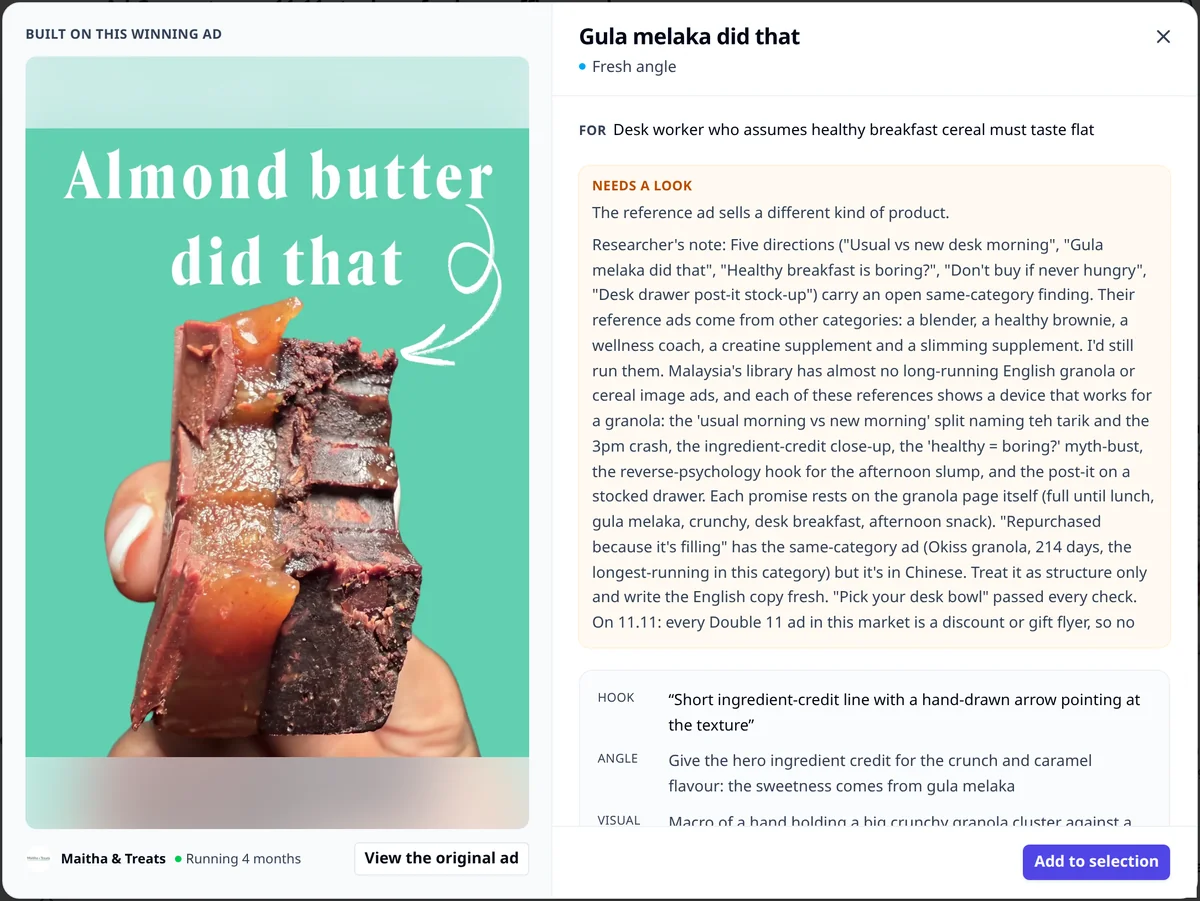
- Click Add to selection on the ideas you like.
For the full walkthrough, see Make your first image ads and The ideas board.
Read the ideas with the checklist above. The research suggests; you decide. An idea built on a brand that sells to a different buyer is still a weak idea, even when the reference ad ran for a year.
Checklist
- Every idea has a buyer, an angle, a hook and a picture.
- Each one comes from a long-running ad, a gap, or your own difference.
- You can prove every claim in it.
- No two ideas give the same reason to buy.
Your homework
Run one research on your best-selling product in the Ad Generator. Open Details › on every idea and shortlist three. For each one, write a single line: why could this work for your buyers? Keep the list. You will use it in the next lesson to choose your three angles.
Frequently asked questions
How many ad ideas do I need before I make ads?
Start with three ideas that give three different reasons to buy. That is enough to learn what your buyers respond to, and few enough to fund on a small budget. Keep the other ideas on your list for the next round.
Can I copy a competitor's ad exactly?
No. Use a winning ad for its structure and its angle, then make it with your own product, your own words and your own proof. Copying someone's photos or design can break copyright, and a copy rarely works as well for a different product.
What if research finds no ads in my category?
Look one step wider: businesses that sell to the same buyer, or the same kind of product in a bigger market. A gap can also be an opening. If nobody in your category shows the product in use, an idea that does can stand out.
Keep exploring
Turn ad research into winning ads
See what 16,000 Malaysian brands advertise, then generate on-brand creative, all in one tool.
7-day free trial · No credit card required