
Module 3 · Make the ads
English, Malay or Chinese: which language?
How to choose the language of your Meta ads in Malaysia, when to mix languages, and how to make a Malay or Chinese version of an ad that already works.
Updated November 2026 · AdPlay.ai Team
Advertise in the language your buyers use when they message you, not the one you are most comfortable in. Many Malaysian businesses run the same offer in more than one language, so the safe path is to start in your main buyers' language, then add a second version of your best ad. Rewrite the hook for each language rather than translating word for word, and test one language change at a time.
Lesson 3.4 · 5 min read
In Malaysia, the same customer may read a menu in English, chat with you in Malay and watch videos in Chinese. So "which language should my ads be in?" has no single answer. It has a method.
Start with your buyers, not your habit
The question is not "what language do I write best?" It is "what language do my buyers use when they talk to me?"
You already have the answer in your phone:
- Open your WhatsApp chats, Facebook comments and marketplace reviews.
- Look at the last 20 messages from paying customers.
- Count the language each one is written in.
If 15 of 20 are in Malay, your first ads should be in Malay, even if your website is in English. If it is mixed, you probably need two versions.
Check what your competitors do
Open the Ad Library and look at the brands you picked in Pick your competitors. Note the language of each ad. You will often find one brand running the same offer in two or more languages at the same time.
Two things to notice:
- Is the offer different, or only the words? A brand that changes the hook for each language is investing in that audience. A brand that runs a direct translation is not.
- Which language versions run longest? As in module 1, a version that runs for months is one the brand keeps paying for.
The Ad Library competitor research guide covers this in more depth.
One language, two, or a mix?
| Your buyers | Start with |
|---|---|
| Mostly one language | Ads in that language only |
| Two clear groups | One ad per language, same angle |
| Everyone mixes in daily chat | Mixed post text, one language on the image |
On the image, use one language. The hook is read in a glance. A line that switches language halfway is harder to take in at that speed.
In the post text, write how your buyers talk. If your customers write "Sedap gila, will order again", a little mixing can sound natural and local. If they write formal Malay, match that.
Rewrite, do not translate word for word
A word-for-word translation keeps the words and loses the voice. Jokes, rhymes and catchy phrases rarely survive it, and the result often sounds stiff. Rewrite the hook for each language so it sounds like something a buyer would say. The angle stays the same, the words change.
Three rules:
- Keep the angle and the offer the same. Only the language changes, so you can compare fairly.
- Have a native speaker read every version. A wrong word or a stiff phrase tells buyers you are not one of them. This matters most for festive greetings.
- Check spelling of product names and prices. Write RM the same way in every version.
A worked example
The home sambal business in Ipoh checks its last 20 WhatsApp orders: 11 in Malay, 6 in English, 3 in Chinese. Its best ad so far is the offer ad in English: "3 jars for RM 45. Free delivery."
The owner makes a Malay version with the same offer and the same layout. The hook is rewritten, not translated: "Stok sambal untuk sebulan. 3 balang RM 45." A friend who grew up speaking Malay reads it and fixes one word.
Both ads run in the same ad set for a week. If the Malay version brings orders at a lower cost, it gets more of the budget, and a Chinese version comes next. If they cost about the same, both keep running, because each reaches different people.
Test one language change at a time
Change the language and nothing else. If the Malay version also has a new photo and a new price, you will not know which change made the difference. Lesson Test one change covers this.
Doing it in AdPlay.ai
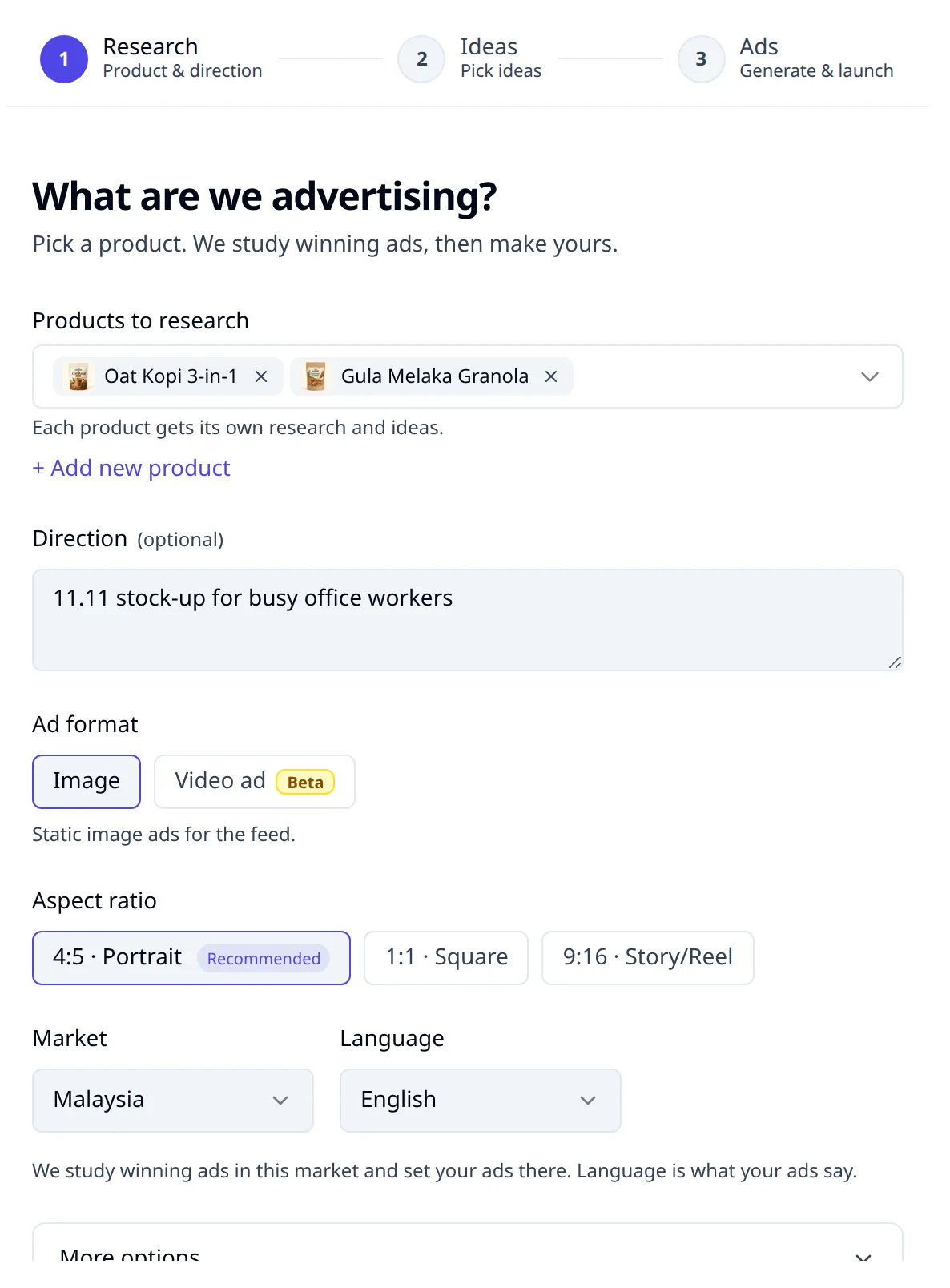
For new ads, pick the language before research. In the Ad Generator, set Language to English, Bahasa Melayu (Malay), 中文 (Chinese) or 繁體中文 (Traditional Chinese). Market is different: it is where the ads run, and the research studies winning ads in that market. Language is only what the ads say.
For a version of an ad you already have, open it from Ads and use Create variant. Set Language to Malay or Chinese and keep the product and the market the same. In What should change? you can add a note, for example "Rewrite the hook for Malay readers, keep the offer 3 for RM 45". You get a new ad with the same layout, named with "(Malay variant)", and the original stays as it is.
A variant is a new image ad, so it uses about 100 credits, or one of the 2 ads on the free trial. See Create variant for more.
Then open the new ad and have a native speaker read the hook, the post text and the headline before you launch.
Checklist
- You counted the language of your real customer messages.
- You know which languages your competitors run.
- The words on the image are in one language.
- Each version keeps the same angle and offer.
- A native speaker read every version.
Your homework
Count the language of your last 20 customer messages. Then use Create variant to make a version of your best ad in your second language. Ask a native speaker to read it, fix what sounds wrong, and keep it ready to launch in module 4.
Frequently asked questions
Can I mix English and Malay in one ad?
Yes, if your buyers talk that way. Mixed post text can feel friendly and local. Keep the words on the image in one language, because people read the image in a glance and a mix slows them down.
Simplified or Traditional Chinese for Malaysia?
For Malaysian buyers, Simplified Chinese is the usual choice. Traditional Chinese fits buyers in Hong Kong or Taiwan. If you are not sure, look at the Chinese ads your competitors run and the script your customers write in.
Do I need a separate campaign for each language?
Not to start. Put the two language versions as two ads in the same ad set and let Meta show each one to the people who respond. Split them later only if you need separate budgets.
Keep exploring
Turn ad research into winning ads
See what 16,000 Malaysian brands advertise, then generate on-brand creative, all in one tool.
7-day free trial · No credit card required