
Malaysia 11.11 & Mega-Sale Ad Playbook (2026)
Run Malaysia's 9.9, 10.10, 11.11 and 12.12 as one connected campaign: the build, sale-window and post-sale phases, the RM mechanics, the audiences to warm before the teaser, and how to scale budget through the peak-day CPM spike without resetting Meta's learning.
Updated August 2026 · Xanny Lee, CEO
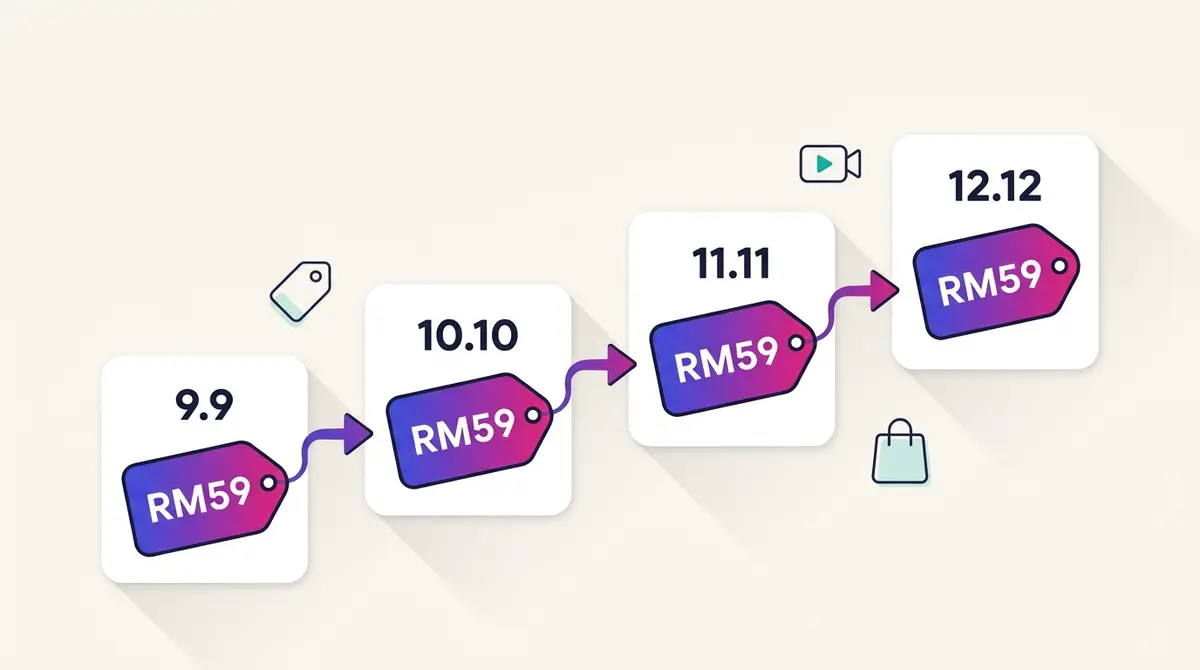
Treat Malaysia's 9.9, 10.10, 11.11 and 12.12 as one connected campaign run in three phases, not four cold launches. In the build phase (4-6 weeks out) you warm the pixel and dataset, build Custom and Lookalike audiences, run cheap cold reach and exit Meta's learning phase on the affordable early dates. In the sale window you run a teaser-to-price-drop-to-urgency-to-final-hours arc. In the post-sale phase you recover carts and re-sell the buyer cohort into the next date. Lead every ad with a concrete RM mechanic (a struck-through anchor like RM569 from RM699, a tiered bundle, a free-shipping threshold), because Shopee Malaysia alone reported RM685 million in shopper savings on 11.11 2025, so the whole feed is on offer. Front-load all creative, audiences and structure before the ramp, because a budget increase over about 20% in one edit resets Meta's learning phase, and peak-day impressions are the priciest of the year, so reserve them for warm, high-intent audiences.
It is the second week of September, your 9.9 ads are still live, and 10.10 is already on the calendar with 11.11 and 12.12 right behind it. Most brands treat each double date as a fresh sprint: new campaign, new audience, new creative, paid from scratch into the most expensive feed of the year. The brands that actually win the season do the opposite. They run the whole ladder as one campaign across three phases, with audiences and creative that compound from one date to the next, budget paced so the costly peak day inherits a stable campaign, and every ad leading with a real ringgit mechanic a thumb can read in a second.
Malaysia's mega sale is a ladder, not a spike
The Western playbook is built around one date: Black Friday, a single weekend you brace for, spend hard on, and recover from. Malaysia does not work that way. The selling year here is a connected chain of double dates that runs 9.9, then 10.10, then the peak at 11.11, then a final 12.12, with the imported Black Friday and Cyber Monday slotting in between. Shoppers do not treat them as separate events either. They wishlist in September, stack vouchers through October, and buy in a burst when the biggest mechanic lands. Plan for one spike and you miss most of the season.
That season sits on a market that is growing fast. Momentum Works, via The Low Down, put Southeast Asia's platform e-commerce GMV at US$157.6 billion in 2025, up 22.8% year on year, the fastest pace in four years, and Malaysia's own platform GMV grew 47.6% across the year, the second-fastest in the region after Thailand. GlobalData forecasts the Malaysian e-commerce market at MYR161.8 billion in 2026, up 9.4% year on year. The prize is real, and it is concentrated into a handful of dates.
The mistake that quietly drains budgets is treating each double date as a cold launch: a new campaign, a fresh audience, brand-new creative, paid from zero into the most crowded feed of the year. Every cold restart pays the expensive auction again to re-warm people you already reached last month, and it restarts Meta's learning on the worst possible day. The brands that win the season run the four dates as one campaign in three phases, with audiences and creative that carry forward, so each date inherits the warmth and the learnings of the one before it.
The 2026 Malaysian year-end sale calendar
Here is the season as a dated reference, so you can plan lead times against real fixtures rather than a vague "Q4". The double dates fall on their own numeric days, the imported Western sales slot between the last two, and a recurring monthly payday spike sits underneath all of them.
| Window | 2026 date(s) | What it is | Ad lead time |
|---|---|---|---|
| 9.9 | Wed 9 September | First double date, cheap dry run | Teaser from late August |
| Gajian (payday) | Around the 25th, monthly | Recurring mid-month salary spike | A warm-audience nudge each month |
| 10.10 | Sat 10 October | Second dry run, weekend traffic | Teaser from early October |
| Deepavali | Sun 8 Nov (replacement Mon 9 Nov) | Festive gifting, collides with 11.11 | Brief with 11.11 in September |
| 11.11 | Wed 11 November | The peak: highest intent and CPM | Build from late September |
| Black Friday | Fri 27 November | Imported, premium-brand bridge | Carry the 11.11 warm pool |
| Cyber Monday | Mon 30 November | Imported online-focused tail | Retarget Black Friday traffic |
| 12.12 | Sat 12 December | The harvest, warmest pool of the year | Re-sell the season's buyers |
Two of those rows are easy to miss. The first is the monthly gajian, or payday, spike. Most Malaysian private employers pay salaries between the 25th and the 30th, and the Accountant General's Department pays civil servants on a fixed date that tends to land around the 25th and shifts earlier before a festival (so the AJobThing salary schedule shows pay arriving on the 22nd in a Chinese New Year month). That gives the calendar a predictable mid-month wave of disposable income, distinct from the double dates, and a good moment to push a warm-audience offer between the big peaks. The second is the Deepavali collision: in 2026 the festival falls on Sunday 8 November with the replacement holiday on Monday 9 November, three days before 11.11, so festive gifting demand and mega-sale demand stack in the same fortnight. Brief both as one creative set in September rather than scrambling in November.
Run the season in three phases: build, sale window, post-sale
The single most useful frame for the whole season is three phases, not four dates. A build phase warms everything before the auction gets expensive, a sale window runs the actual creative arc across each peak, and a post-sale phase turns the traffic you paid for into the seed of the next campaign. Each phase has a different job and a different cost profile.
| Phase | When | The job | Spend profile |
|---|---|---|---|
| Build | 4-6 weeks out | Warm the pixel and dataset, build Custom and Lookalike audiences, seed creative, run cheap cold reach, exit the learning phase early | Low daily budget, mostly cold prospecting and tests |
| Sale window | The 2-3 weeks around each peak | Run the teaser-to-price-drop-to-urgency-to-final-hours arc, weight spend to warm and cart audiences | The bulk of spend, concentrated on and around the peak day |
| Post-sale | The days after each peak | Recover carts, upload buyers, build the next lookalike, re-sell into the next date | A smaller, profit-focused harvest budget |
The build phase is where most of the season is quietly won or lost, because it is the only phase where impressions are cheap and mistakes are forgivable. Use it to get your Meta pixel and Conversions API firing clean events, to build and start warming your audiences, and to run a few cheap cold-reach and creative tests so you know which hook and offer to scale later. Critically, it is also where you exit Meta's learning phase, which is the whole reason to start early (more on that below).
The sale window is the part everyone pictures: the live promotion around each double date. The job here is not to discover what works (you did that in the build phase) but to execute the creative arc against the clock, with the budget weighted hard toward the warm and high-intent audiences who convert when the price is highest.
The post-sale phase is the one brands skip, and it is the most profitable. The day after a peak you are sitting on the freshest, highest-intent data of the year: everyone who viewed, added to cart, watched a livestream clip or bought. Recover the carts that did not check out, upload the buyers, build a fresh lookalike off them, and re-sell the cohort into the next date on the ladder. Done across the whole chain, the post-sale phase of 11.11 becomes the build phase of 12.12.
Give each double date a different job
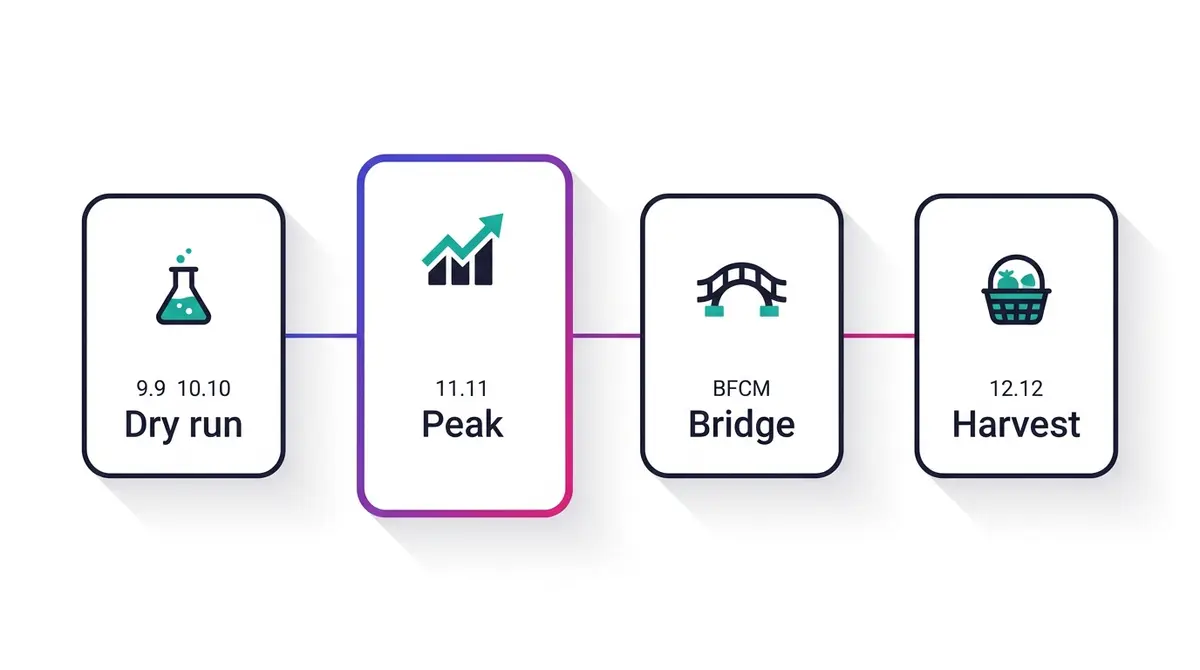
Inside that three-phase frame, each date can specialise instead of competing with itself. The cheaper early dates earn their keep as dry runs; the peak earns the budget; the tail harvests what the chain built.
| Date | Its job in the chain | Where the budget goes |
|---|---|---|
| 9.9 / 10.10 | Cheaper dry runs: test hooks, prove offers, seed warm audiences | Mostly cold prospecting, small budget, lots of creative tests |
| 11.11 | The peak: highest intent, highest CPM, biggest mechanic, warmest audiences | The bulk of spend, weighted to warm and high-intent audiences |
| Black Friday / Cyber Monday | The import and premium-brand bridge | Higher-ticket and premium pushes, retargeting the 11.11 pool |
| 12.12 | The harvest: warm retargeting converts cheapest | Retargeting the season's whole warm pool, profit-focused |
The data backs the shape of this ladder. Lazada Malaysia reported its LazMall average order value on 11.11 2025 was 20% higher than its own 9.9 campaign and 13% higher year on year, a sign that the peak pulls higher-value, premium-brand buying than the warm-up dates do. That is exactly why 9.9 and 10.10 are the right place to spend small and learn cheap: you are not chasing the big basket yet, you are finding the hook and offer that you will scale when the intent peaks at 11.11.
Treat 12.12 as the payoff date. By then you are sitting on the warmest retargeting pool of the year: everyone who clicked, watched, added to cart or bought across the previous three dates. Warm retargeting is the cheapest reach you can buy in an expensive season, so 12.12 is usually where the campaign finally turns a clean profit, and where you re-sell to 11.11 buyers before Chinese New Year.
Lead every ad with a real ringgit mechanic
On a sale day the entire feed is discounting, so a red SALE banner says nothing. Shopee Malaysia reported RM685 million in shopper savings via vouchers and promotions on 11.11 2025 (RM170 million of that from livestream and video deals alone), and over RM500 million on its 9.9 Super Shopping Day. When every brand is shouting "sale", the only thing that stops the scroll is a specific number the shopper can read in one glance.
So bake the mechanic into the creative itself, in the first frame, not in the caption. The mechanics that work fall into a handful of shapes:
- A struck-through price anchor: RM569 from RM699, the discount visible as a number, not a percentage in the small print.
- A tiered bundle: 10% off one, 17% off two, 23% off three, which nudges the basket up.
- A free-shipping or cash-on-delivery threshold under RM100, since unexpected delivery cost is a top reason shoppers abandon.
- A gift with purchase, which adds value without discounting the hero product.
- Social-proof volume: "12,000 sold this season", which borrows the crowd's confidence.
Match the mechanic to the category, because what lifts a beauty basket is not what moves an air purifier. An electronics seller runs the price-anchor play: an air purifier at RM569 from RM699, the struck-through number that reads instantly in a peak-day feed, the right shape for electronics and home where shoppers compare on price. A skincare brand leans on the bundle that lifts basket size, a five-piece routine set around RM58, the move beauty brands use across 9.9 to 12.12 to raise average order value rather than just discount. A modest-fashion label runs the hard offer plus urgency: three simple hijabs for RM100, today only, the multi-piece "three for RM" deal with a real deadline that carries the sale-day urgency wave. And a jewellery brand shows the flash-window angle, a named piece at a set price where the packaging and the pause carry the desire, the way gold and jewellery brands run numbered flash windows through the double dates.
Build the audiences before the teaser, not on sale day
The auction you bid into is enormous: DataReportal's Digital 2026 report put Facebook's advertising reach in Malaysia at 23.0 million people at the end of 2025. You do not want to meet that audience cold for the first time on the most expensive day of the year. You want to arrive on 11.11 with warm pools already built and the cold reach already paid for in the cheap weeks.
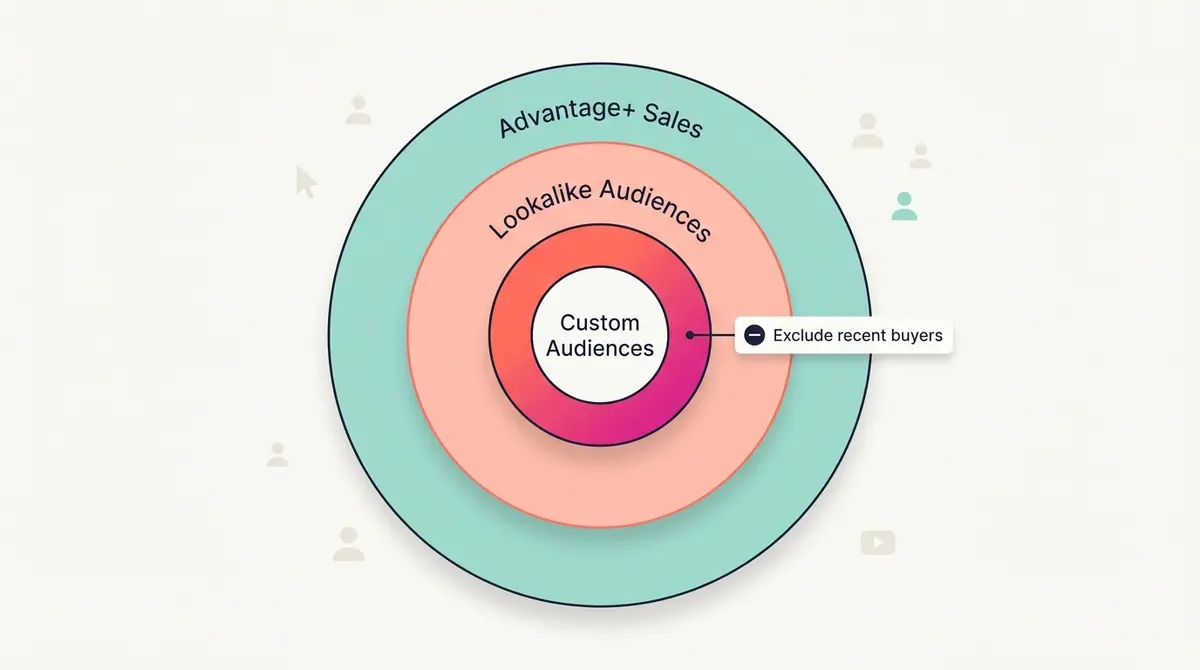
Build the warm audiences first, because they are the cheapest to convert and deserve the costly peak-day budget. Custom Audiences are your warmest signal: past buyers, site visitors, cart and checkout abandoners, video viewers, and your uploaded email or phone list. Lookalike Audiences do the prospecting: start at 1% off your best customers for precision, then widen to 2-3% when you need scale at the peak. Exclude recent purchasers so you do not burn peak CPMs re-reaching people who already bought.
The mechanics here have shifted, so use the current vocabulary. What used to be Advantage+ Shopping campaigns were renamed Advantage+ Sales campaigns in 2025, and that is now the AI-driven default for a sale objective. Rather than hand-building every audience, you feed Advantage+ Sales your custom-audience and lookalike signals plus your exclusions, and Meta's system does the matching. Detailed targeting still exists in Ads Manager in 2026, but per Meta's own documentation and Social Media Today's reporting it now behaves as a suggestion or starting hint rather than a hard filter in most objectives. Meta consolidated many narrow interests from 23 June 2025, and campaigns still relying on discontinued interests stopped delivering on 15 January 2026, so an audience built on a niche interest from a few years ago may simply have stopped spending. Detailed-targeting exclusions were also removed, which is why recent-buyer suppression now has to run through custom-audience exclusions instead. The conversion signal feeding all of this is your dataset and Conversions API, so make sure it is firing clean events well before the season starts.
Pace the budget through the CPM spike, do not jump it
Here is the rule that decides whether your peak day delivers: front-load everything before the ramp, then scale gently, because peak-day impressions are the priciest of the year and a clumsy budget jump can stall delivery exactly when it costs most. As a directional proxy for the shape (not a Malaysian rate), Gupta Media's CPM tracker put Meta's Cyber Monday 2024 CPM at US$17.70, about 138% above the year's roughly US$7.43 annualized average, with Black Friday at US$16.85. Those are US and global delivery aggregates, so read them as the seasonal pattern Malaysia sits inside, not as a local ringgit CPM. The lesson travels regardless: peak-day impressions cost a lot, so you cannot afford to waste them or to interrupt their delivery.
The constraint that catches most brands is Meta's learning phase. When you create a new ad set or make a significant edit, the delivery system enters a learning phase where performance is less stable and cost per result is usually worse while it explores. To exit, an ad set needs roughly 50 optimization events in about 7 days, per Meta's Business Help Center. The danger is that several common "scaling" moves restart that learning at the worst possible moment. A budget increase of more than about 20% in a single edit resets it, and so do a new audience, a creative swap, a changed optimization event and a changed bid strategy (Jon Loomer documents the same edit-reset behaviour). Resetting learning on 11.11 means paying the year's highest CPMs while the algorithm relearns from scratch, which is the most expensive mistake in the season.
So the playbook is to do all the disruptive work in the cheap weeks. Build your creative, audiences and campaign structure during the build phase, run them on 9.9 and 10.10 so the ad sets accumulate their 50 events and exit learning while impressions are affordable, and arrive on 11.11 with an already-exited, stable campaign. Then add spend two ways:
- Vertical scaling: raise the budget on a proven, exited ad set, but in steps of about 20% every few days rather than one big jump, so each increase stays under the learning-phase reset threshold.
- Horizontal scaling: duplicate a winning ad set onto a fresh warm or lookalike audience at a smaller test budget, which adds reach without touching the champion's delivery.
If you want the underlying economics of why peak impressions cost what they do, the CPM mechanics are worth understanding before you set budgets, and the Malaysian cost picture gives you a local frame for what "affordable" means in the cheap weeks.
There is a discipline that goes with this: a no-touch window. Once the sale week is live, treat the exited ad sets as off-limits to big edits. Safe changes that do not restart learning include editing the copy or headline inside an existing ad, adjusting the schedule, and nudging the budget by under about 20%. The edits that quietly reset learning, the ones to avoid mid-sale, are a budget jump over 20% in one go, swapping or adding creative, adding a new audience, changing the optimization event, and switching the bid strategy. On a one-week sale where every hour is expensive, the instinct to fiddle is the budget-killer. If a change is genuinely unavoidable, make all of it in a single edit so you reset learning once rather than repeatedly.
Run each peak as a teaser-to-urgency creative arc
With the budget paced and the warm pools reserved for the peak, the job inside each wave is to match the message to the moment and let the audience narrow as it moves from cold curiosity to warm urgency. This is the creative arc the season turns on:
| Wave | What the ad says | Who it targets | Best format |
|---|---|---|---|
| Teaser | "Something big lands on 11.11. Wishlist now." Curiosity, no price yet | Cold prospecting and 1-3% lookalikes | Short 9:16 video, single static |
| Price-drop | The RM mechanic in the first frame (RM569 from RM699) | Warm Custom Audiences plus narrowed lookalikes | 1:1 or 4:5 static, carousel |
| Urgency | "Live now, ends midnight." Runs against a real deadline | Cart and checkout abandoners, engaged viewers | 9:16 vertical video under 15 seconds |
| Final hours | "Last few hours. Stock running out." Catches procrastinators | Cart abandoners, recent product viewers | Static with countdown, dynamic product ads |
| Post-sale recovery | "Missed it? One more day for cart items." | Buyers (for the next date) and abandoners | Dynamic product ads, single static |
The formats follow the wave: 9:16 vertical video under 15 seconds with the price in the first frame for urgency, 1:1 or 4:5 single statics for a price drop a thumb reads in a second, carousels when several deals share one budget, and dynamic product ads from your catalog for retargeting. Vertical video and static specs differ per placement, so build each wave to the right size, and a short sale video can do the urgency work the static cannot. If you are sequencing those hooks for the first time, lead with a hook the thumb stops for and test your sale hooks on the cheaper double dates before the peak, where the impressions are cheap and a failed test costs little.
A worked RM campaign timeline
To make the phases concrete, here is one illustrative week-by-week plan for a mid-size electronics brand building toward 11.11. The ringgit figures are illustrative daily budgets to show the shape of the spend, not a benchmark, and the cold-versus-warm split is the part that actually matters.
| Week | Phase | Daily budget | Cold / warm split | What runs |
|---|---|---|---|---|
| Weeks 6-5 out | Build | RM80 | 90% cold / 10% warm | Cheap cold reach, 3-4 hook tests, pixel and audiences warming |
| Weeks 4-3 out | Build (9.9, 10.10) | RM150 | 70% cold / 30% warm | Dry-run the offer on the early dates, exit learning, find the winner |
| Week 2 out | Build to teaser | RM200 | 60% cold / 40% warm | Teaser wave live, lookalikes widened to 2-3%, scale the winner +20% steps |
| Ramp week | Sale window | RM350 | 40% cold / 60% warm | Price-drop wave, warm audiences front of queue, no big edits |
| 11.11 peak day | Sale window | RM900 | 25% cold / 75% warm | Urgency and final-hours waves on warm and cart audiences |
| Days after | Post-sale | RM250 | 10% cold / 90% warm | Recover carts, upload buyers, build the next lookalike for 12.12 |
Read the pattern, not the numbers. The daily budget climbs as the season ramps, but the proportion of cold reach falls the whole way: you do your introductions when impressions are cheap, and you reserve the peak-day budget, the most expensive money you will spend all year, for the warm and cart audiences who are likeliest to buy at the moment the price is highest. The peak-day step from the ramp week is large, but because the proven ad sets exited learning weeks earlier and you scaled in roughly 20% increments to get there, the campaign is stable when the costly day arrives rather than freshly reset. A skincare label or a fashion store would run the same shape with different mechanics and a different basket size.
Retarget the audiences the sale itself builds
The sale window is not just a spending event; it is an audience-building event, and the pools it generates are the cheapest, highest-intent reach you will buy. Each wave of traffic creates a distinct retargeting layer you can recapture later in the window and in the post-sale phase:
- Product and page viewers from the teaser wave: warm but not yet committed, ideal for the price-drop wave.
- Add-to-cart and initiate-checkout abandoners from sale-day traffic: the highest-intent pool of all, the people who got to the edge and stopped.
- Video viewers of your livestream-promo and urgency clips: a large, cheap warm pool to carry into the next date.
- Engagement custom audiences: people who reacted, commented on or saved your teaser and price-drop ads.
Hit the cart and checkout abandoners in the final hours with the exact item they viewed, a free-shipping nudge and a closing-soon reminder, because the Baymard Institute, averaging 50 studies, puts online cart abandonment at 70.22%, with unexpected costs at checkout the single most-cited reason. So show fees and free-shipping thresholds up front, in the ad and on the page. Warm retargeting recovers sales at a fraction of cold-traffic cost, which matters most when cold-traffic cost is at its annual peak. Because a week-long sale fatigues creative fast, rotate creative before a week-long sale fatigues the audience, and read the numbers that survive the peak-day noise, hook rate, CTR, cost per result and frequency, rather than the impression and reach counts that climb for everyone at the peak. One reporting detail catches people out: set your historical comparison range to last year's actual promotion dates, not the calendar month, or you will compare a sale week against an ordinary one and misread the result.
Put livestreams and the marketplace sale to work
Livestreams are no longer a side channel in Malaysia; they are a core mega-sale engine. Momentum Works reported content and live commerce hit US$49.7 billion, or 32% of Southeast Asia's platform GMV in 2025, up from 20% a year earlier. The lift is concrete: Shopee Malaysia said local sellers using Shopee Live and Shopee Video on 11.11 2025 saw up to 26 times more orders than on a normal day, against more than 1.3 billion Live and Video views. TikTok Shop's regional GMV roughly doubled to US$45.6 billion in 2025, with Malaysia among the fastest-growing markets in the region (the H1 2025 Momentum Works and TabCut report, carried by TNGlobal, had already flagged Malaysia as the fastest-growing market with GMV up around 150% year on year in the first half).
The 2025 11.11 mechanics show exactly what an appointment-style ad can point at. Per Marketing-Interactive's reporting, Lazada ran a 28-hour pre-sale that started at 8pm on 10 November, with hourly RM11 deals on items from mobile phones to gold jewellery and a "Crazy brand mega offer" of up to 90% off. Shopee ran a 12-hour non-stop Shopee Live marathon plus free shipping with no minimum spend and an RM50-voucher ICON Hunt, while TikTok Shop ran an on-ground 11.11 carnival from 7 to 9 November at Pavilion Bukit Jalil, with stackable discounts up to 30% and buy-1-free-1 offers. Those are real deadlines, not generic ones.
Your Meta ads should feed those streams, not compete with them. Promote each live slot with an appointment-style ad two days out ("Lazada hourly RM11 deals start 8pm tonight"), and use a clip from a previous stream as the creative so people see what they are tuning in for. The marketplace sale and your own store then run in parallel with different jobs. The marketplaces carry the traffic, the stacked platform vouchers and the trust during the window. Your own store keeps the margin and earns the exclusive bundles, gifts and early access you reserve for past buyers, where buy-now-pay-later framing ("RM569 or 3 x RM190") removes the last objection on a higher-ticket cart. If several deals are competing for one budget, show several deals in one carousel so a single ad set can route spend to whichever offer is pulling.
Plan the post-sale cohort and the next date
The most valuable output of the season is not the revenue; it is the cohort. Your 11.11 and 12.12 buyers are the highest-intent seed list you will build all year. Upload them, build a fresh lookalike off them, and capture their reviews and unboxing clips as the social proof for the next sale's creative. Then re-sell into 12.12 and Chinese New Year, where the acquisition cost finally turns a clean profit on people you already won. This is the build phase of the next date happening for free, which is exactly why the three-phase loop compounds across the ladder instead of resetting four times.
The thread through all of it is the loop: study which rivals' sale angles repeat every year in the free Meta Ad Library, generate the on-brand creative with the RM mechanic baked in, launch it to Meta, then read the result and feed it into the next double date. A platform like AdPlay.ai keeps that research, generation, editing and Meta launch in one place, which is what makes running four connected dates as one campaign manageable instead of four scrambles. For the dates and lead times that anchor the whole thing, the full 2026 Malaysian selling calendar is the guide to plan against.
By the numbers
Frequently asked questions
Should I run all four double dates (9.9, 10.10, 11.11, 12.12) or just 11.11?
Run the ladder, not the spike. In Malaysia the mega sales are a continuous chain from 9.9 through 10.10, 11.11 and 12.12, with Black Friday and Cyber Monday imported in between, so treating only 11.11 as the event wastes the cheaper dates that exist to do real work. Use 9.9 and 10.10 as low-cost dry runs to test hooks and seed warm audiences, make 11.11 the peak where intent, budget and the biggest mechanic all land, and let 12.12 harvest the warm retargeting pool you built across the chain. The same creative library and audiences should carry from one date to the next instead of being rebuilt cold each time.
When should I start running ads for the mega sales, and how far ahead?
Start building 4-6 weeks before the peak, because the sales are not one-day events. Shopee Malaysia's campaign windows run roughly three weeks around the peak day (2024 ran 26 October to 13 November), and shoppers browse, wishlist and stack vouchers for weeks before buying in a burst. Have your Custom Audiences (past buyers, site visitors, cart abandoners, video viewers) and Lookalikes built and warming before you announce anything, run a teaser or early-bird wave to build demand and seed audiences, then move to the price-drop announcement and sale-day urgency. The point of starting early is also to exit Meta's learning phase on the cheap dates, so the costly peak day inherits a stable, exited campaign. For the 2026 calendar, brief Deepavali (Sunday 8 November, with the replacement holiday Monday 9 November) and 11.11 together, since they collide in the same fortnight.
What offer mechanic converts best on a Malaysian sale day?
A concrete one the shopper can read in a single glance, matched to your category. A struck-through price anchor (RM569 from RM699) reads instantly for electronics and home; a routine bundle with a free-gift sample lifts basket size for skincare; a multi-piece 'three for RM100' deal with a real deadline carries urgency for modest fashion; a free-shipping or cash-on-delivery threshold under RM100 removes the last objection. A generic red SALE banner is invisible in a feed where every brand runs the same graphic. Shopee Malaysia reported RM685 million in shopper savings on 11.11 2025, so assume the entire feed is discounting and make your specific number the thing that stops the scroll.
How do I scale budget into 11.11 without resetting Meta's learning phase?
Front-load the structure, then scale gently. An ad set needs roughly 50 optimization events in about 7 days to exit Meta's learning phase, and a budget increase of more than about 20% in a single edit pushes it straight back in, as do new audiences, creative swaps, a changed optimization event and a changed bid strategy. So build all your creative, audiences and campaign structure before the ramp, exit learning on the cheaper 9.9 and 10.10 dates, then scale vertically in steps of about 20% every few days (or duplicate a proven ad set onto a fresh audience to scale horizontally). The goal is to arrive on 11.11 with an exited, stable campaign rather than a fresh reset on the most expensive day of the year.
How much should I budget for a Malaysian mega-sale campaign, and how do I split it across the phases?
There is no single right number, but the split matters more than the total. Spend small daily amounts on cheap cold reach in the build and teaser weeks (this is where impressions are affordable and you are seeding audiences and learning), and reserve the bulk of the budget for the warm and high-intent audiences on and around the peak day. A workable shape for a smaller brand: a low daily test budget for several weeks out, a step-up in the ramp week, then a peak-day push that is heavily weighted to warm and cart audiences, with a smaller tail for the post-sale harvest. The worked RM timeline below shows one version of this split. Whatever the size, keep cold reach in the cheap window and warm conversion in the expensive one.
Which audiences should I build for the mega sales, and who should I exclude?
Build warm before you prospect cold. Custom Audiences (past buyers, site visitors, cart and checkout abandoners, video viewers, and your uploaded email or phone list) are the warmest and cheapest to convert, so they take the expensive peak-day budget. Lookalike Audiences off your best customers (1% for precision, widening to 2-3% for peak scale) do the prospecting in the cheaper teaser window. Exclude recent purchasers so you do not pay peak CPMs to re-reach people who already bought. Note that detailed-targeting exclusions were removed in 2025, so suppress recent buyers through custom-audience exclusions instead.
How do I retarget the people who browsed during the sale but did not buy?
Build the retargeting layers from the traffic the sale itself generates, then recapture them in the final-hours and post-sale waves. The teaser wave creates product and page viewers; sale-day traffic creates add-to-cart and initiate-checkout abandoners; livestream-promo clips create video-viewer audiences; and the ads themselves create engagement custom audiences (people who reacted, commented or saved). Each is a cheap, high-intent pool. Hit cart and checkout abandoners with the exact item viewed plus a closing-soon nudge during the final hours, then carry video viewers and engagers forward as warm prospecting into the next double date. Show fees and free-shipping thresholds up front, since the Baymard Institute, averaging 50 studies, puts cart abandonment at 70.22%, with unexpected costs the most-cited reason.
Which mid-sale edits are safe, and which ones will tank my delivery?
On a one-week sale where every hour is expensive, the classic budget-killer is panicking and editing. Safe edits that do not restart learning: tweaking the copy or headline inside an existing ad, adjusting the schedule, and nudging the budget by under about 20%. Edits that reset the learning phase at the worst possible moment: a budget jump over about 20% in one go, adding or swapping creative, adding a new audience, changing the optimization event, and switching the bid strategy. If you genuinely must make a big change mid-sale, make all of it in one edit rather than several, so you reset learning once instead of repeatedly.
Sources
- 1.Momentum Works (Ecommerce in Southeast Asia 2026) via The Low Down (2026)
- 2.DealStreetAsia, SE Asia e-commerce GMV hit US$157.6b in 2025 (Momentum Works) (2026)
- 3.Media OutReach Newswire, Local Sellers Unlock 14X More Orders During Shopee's 11.11 Big Sale (2025)
- 4.New Straits Times, Shopee 9.9: Malaysians saved RM500m, enjoyed 14x quicker delivery (2025)
- 5.The Rakyat Post, Malaysians Shift to Premium Online Shopping During Lazada's 11.11 (2025)
- 6.Marketing-Interactive, Malaysia's 11.11 showdown: How Shopee, Lazada, TikTok Shop are engaging shoppers (2025)
- 7.TNGlobal, TikTok Shop doubles global GMV in H1 2025 with Malaysia up 150% (Momentum Works / TabCut) (2025)
- 8.TNGlobal, TikTok's Southeast Asia doubles GMV to US$45.6B in 2025 (Momentum Works) (2026)
- 9.DataReportal, Digital 2026: Malaysia (2026)
- 10.Gupta Media, Social Media Ads Cost and CPM Tracker (2025)
- 11.Meta Business Help Center, About the learning phase (2026)
- 12.Jon Loomer Digital, Facebook Ads Edits that Trigger the Learning Phase (2026)
- 13.Baymard Institute, Cart Abandonment Rate Statistics (2026)
- 14.GlobalData, Malaysia Ecommerce Market to Register 9.4% Growth in 2026 (2026)
- 15.Jon Loomer Digital, Advantage+ Sales Replaces Advantage+ Shopping (2025)
- 16.Social Media Today, Meta Is Consolidating More of Its Detailed Ad Targeting Options (2025)
- 17.Meta Business Help, Updates to Detailed Targeting (2026)
- 18.Sprout Social, Social Media Image Sizes Guide (2026)
- 19.AJobThing, Salary Schedule (Jadual Gaji) in Malaysia (2026)
Keep exploring
Turn ad research into winning ads
See what 16,000 Malaysian brands advertise, then generate on-brand creative, all in one tool.
7-day free trial · No credit card required